
1. Hazardous events and casualties
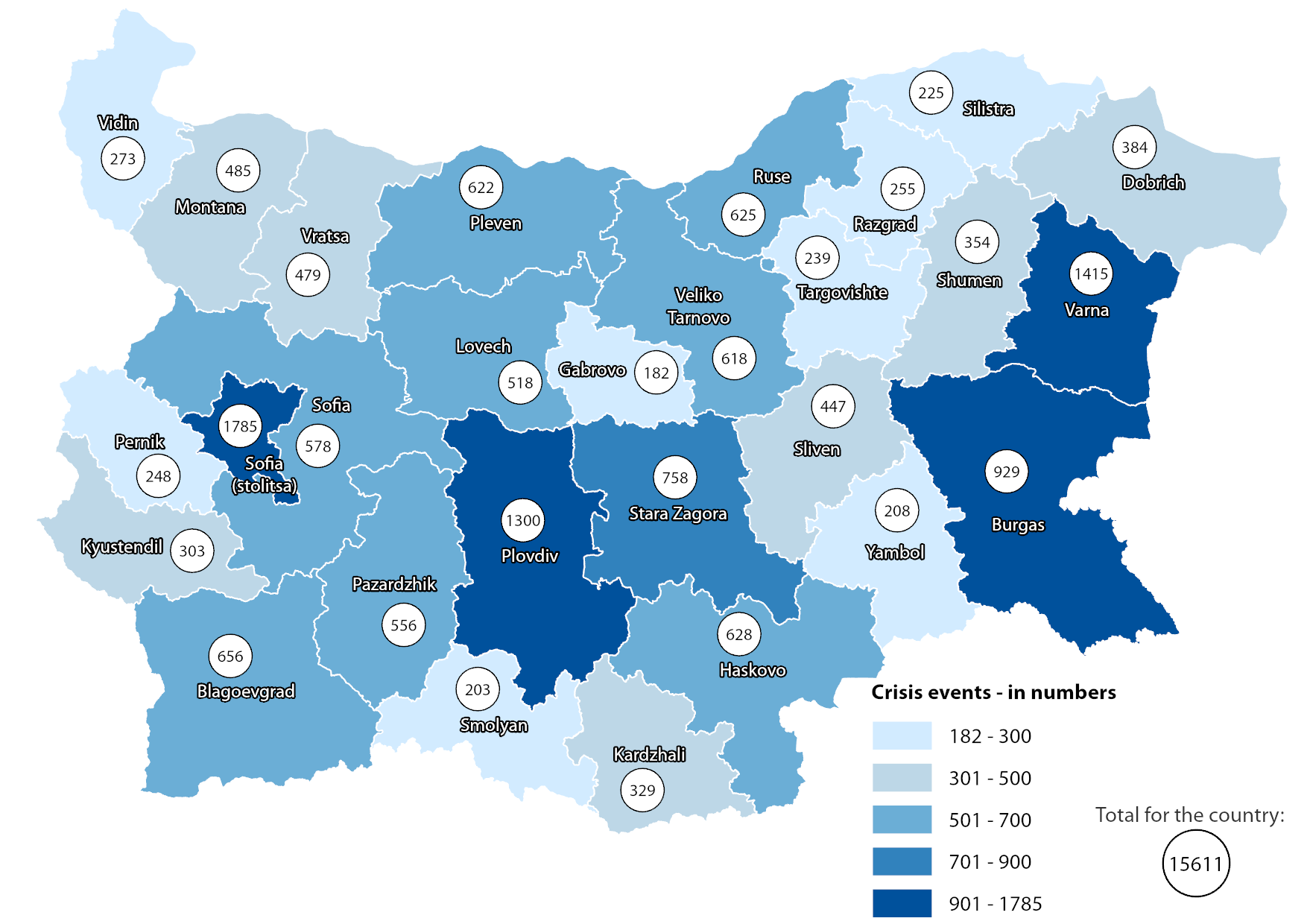
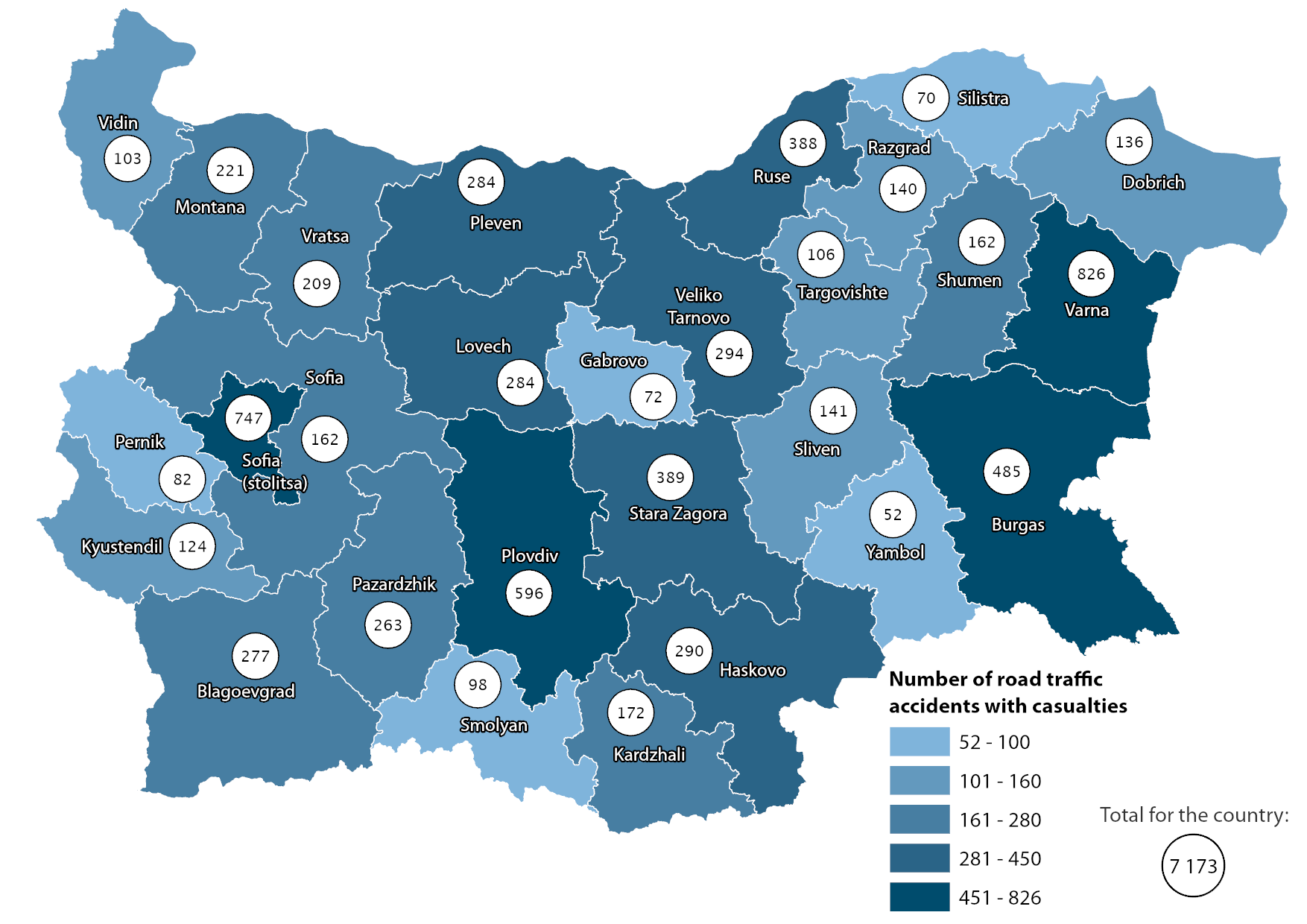
In 2024, there were 15 611 hazardous events (disasters, accidents and crises), representing an increase of 4.3% compared to the previous year. The highest relative share is occupied by fires resulting in material damage1 - 50.2%, followed by road traffic accidents with casualties2 - 45.9%. The annual increase for fires is 4.7%, and for road traffic accidents - 2.5%. An increase in the number of events compared to the previous year is also observed for extreme temperatures (119.4%) and 'drought' - 28.7%.
Fig. 1. Number of hazardous events by districts in 2024
1 Fires - the survey includes fires resulting in casualties or material damage.
2 Road traffic accidents - includes road accidents with casualties.
Fig. 3. Number of fires with casualties or material damage by regions in 2024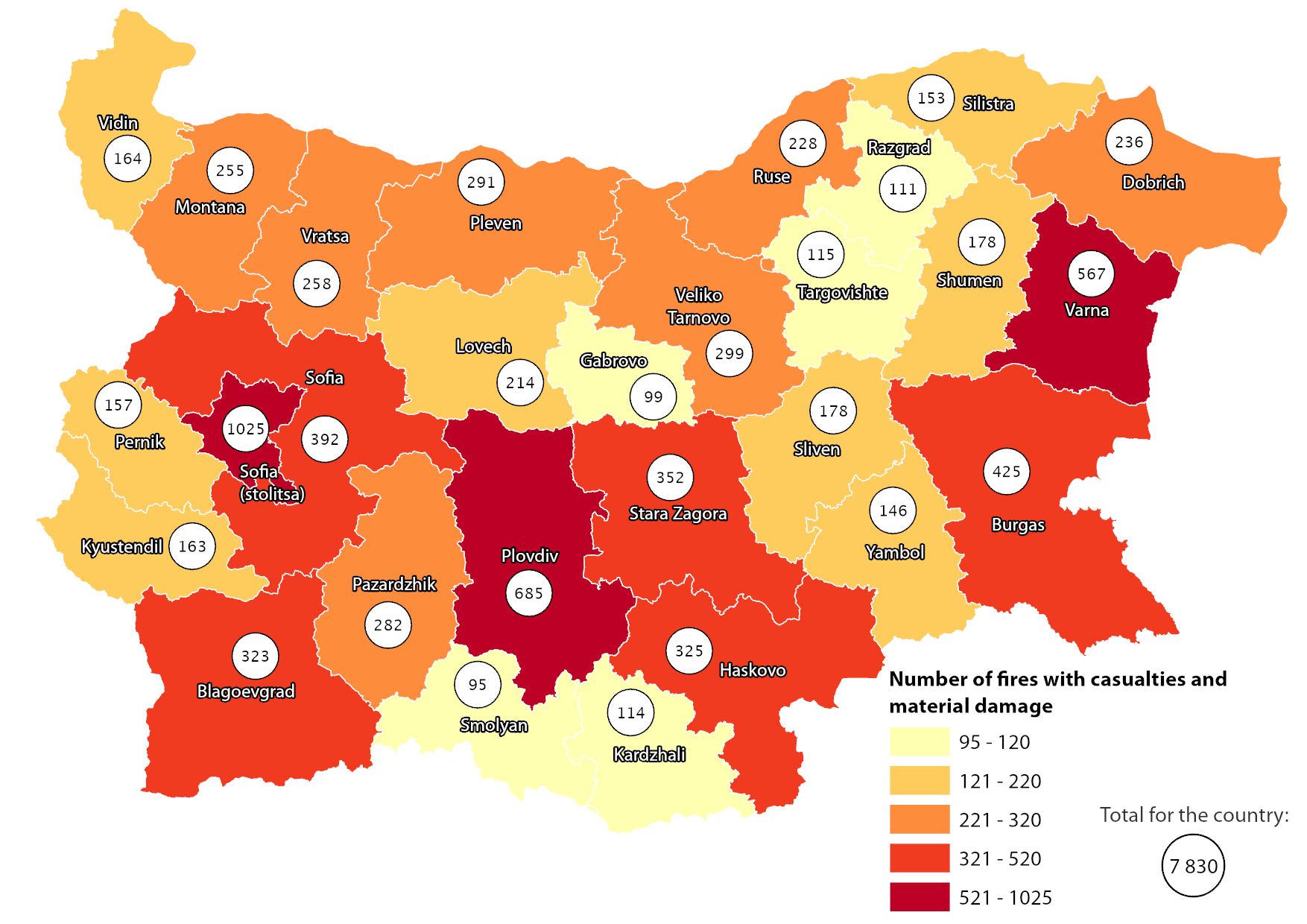
Fig. 4. Number of road traffic accidents with casualties by regions in 2024
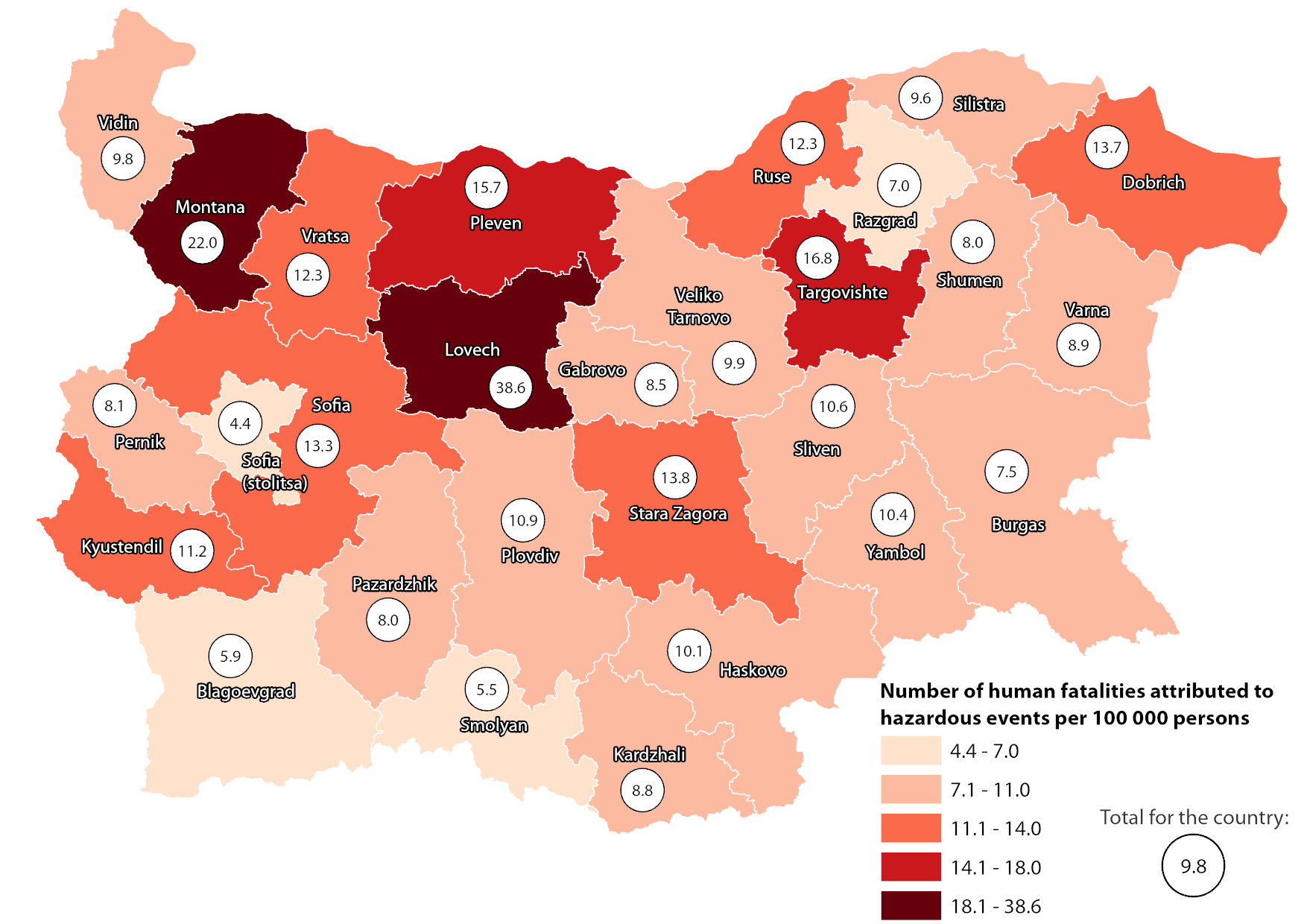
In 2024, the number of human fatalities resulting from disasters, accidents and crises was 630, or 9.8 per 100 000 people of the country’s population. The highest share of them is occupied by those who died in transport accidents - 478 persons, followed by those who died in fires - 124 persons. The districts with the most fatalities were Plovdiv - with 69 people and Sofia (stolitsa) - with 57 people, while the fewest were observed in Smolyan - 5 persons.
Fig. 6. Number of human fatalities attributed to hazardous events per 100 000 people by district in 2024
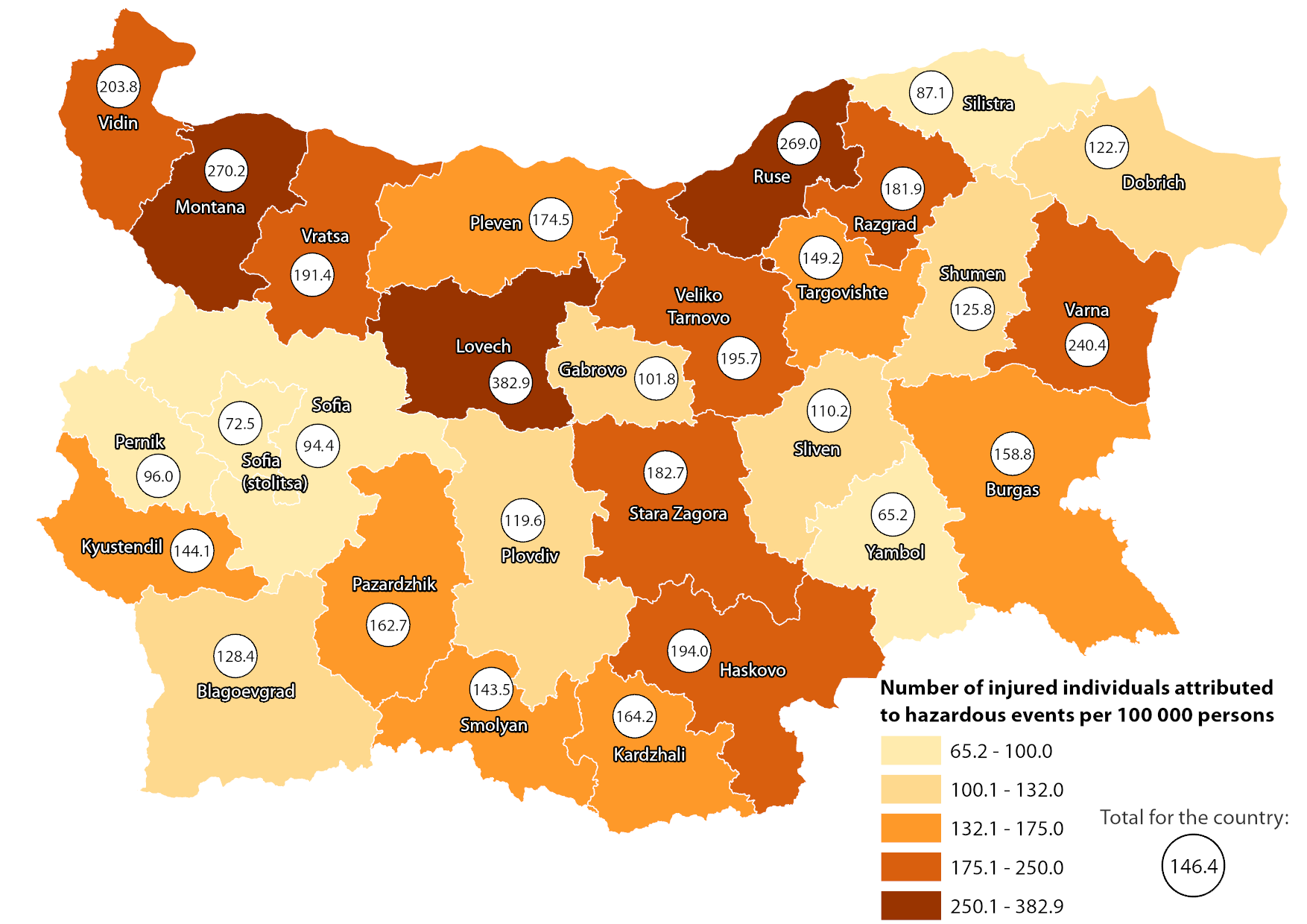
The total number of injured individuals for the year was 9 429, or 146.4 persons per 100 000 people of the country's population. The highest relative share of injured persons was recorded in road traffic accidents - 96.0% and in fires - 3.6% of all injured persons. Regionally, the highest numbers of injured persons were reported in the districts of Varna - 1 048, Sofia (stolitsa) - 936 and Plovdiv - 759.
Fig. 8. Number of injured individuals attributed to hazardous events per 100 000 people by district in 2024
2. Disasters
In 2024, the country experienced a total of 38 hazardous events for which a state of emergency was declared, that is 66 less than the previous year and 11 less than in 2022. Among these, the largest share is held by disasters related to forest fires, floods, drought, and hailstorms. Compared to 2023, an increase is noted in the declared states of disaster resulting from a lack of water for drinking and domestic needs (drought).
As a result of the occurred disasters, four individuals lost their lives.
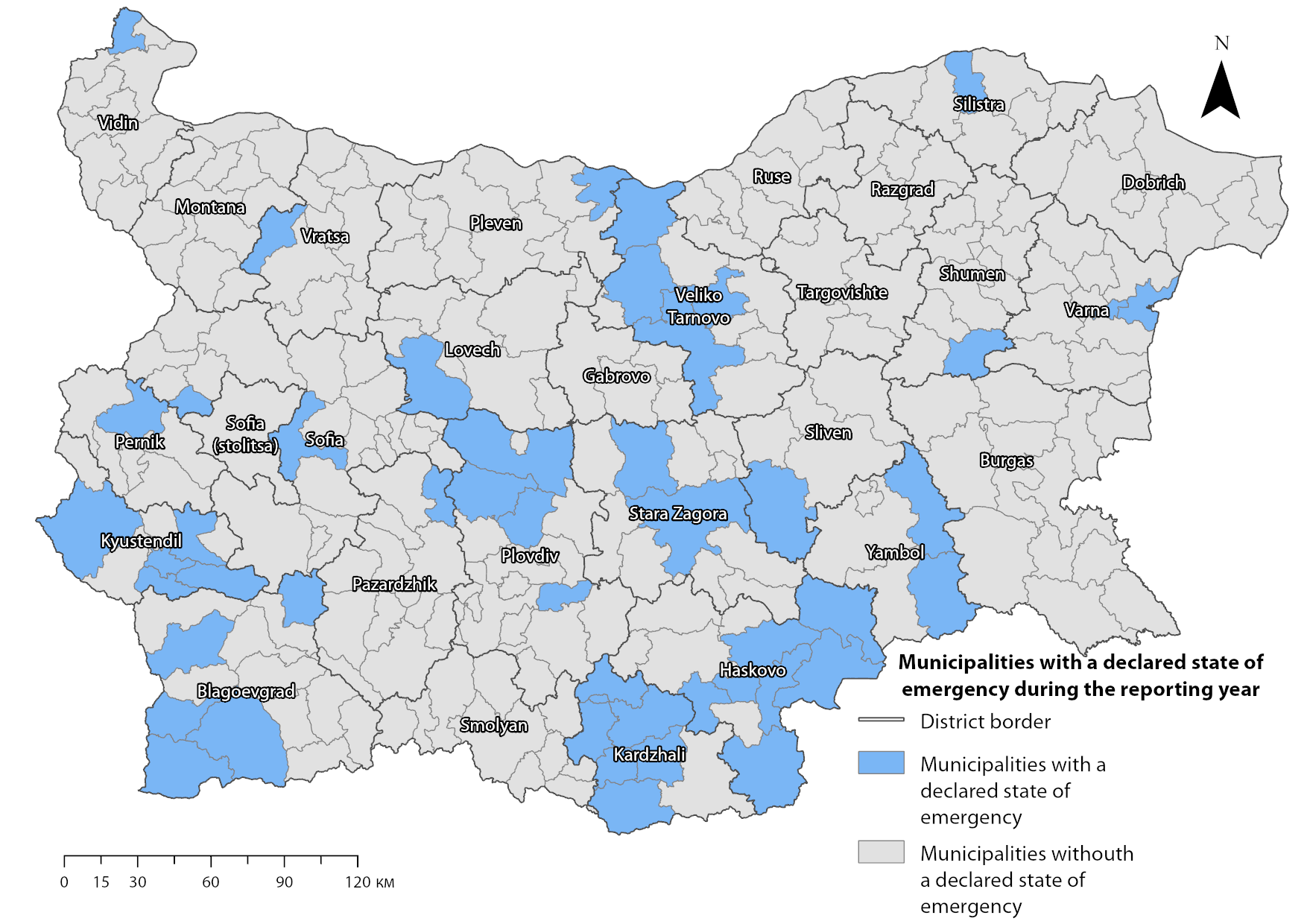
In 2024, disasters partially or fully affected the territory of 47 municipalities from 19 administrative districts in the country. The total population in the municipalities affected by disasters was 1 308 715 people, or 20.3% of the country’s population.
Fig. 9. Municipalities with a declared full or partial state of emergency in 2024
3. Public expenditures for hazardous events
According to NSI's estimates, in 2024 the expenditures for preparedness, prevention, response, and recovery from hazardous events in the ‘General Government’ sector were BGN 1 578 700 thousand, or 0.77% of the country’s GDP.
In 2024, the total expenditures for crisis events decreased by 2.5% compared to the previous year, while the expenditures from the state budget increased by 4.1%, reaching BGN 1 550 600 thousand.
In 2024, the majority of reported expenditures were allocated to 'recovery' (50.3%) and 'preparedness' (40.7%), whereas in 2023, the expenditures for preparedness had the highest share (46.5%).
Table 1. Expenditures for hazardous events by use for the period 2021 - 20241
| Use | Year | |||||||
| 2021 | 2022 | 2023 | 2024 | |||||
| Thousand BGN | % | Thousand BGN | % | Thousand BGN | % | Thousand BGN | % | |
| Total | 7408400 | 100.0 | 4309300 | 100.0 | 1619200 | 100.0 | 1578700 | 100.0 |
| Prevention | 349700 | 4.7 | 420800 | 9.8 | 227300 | 14.0 | 104400 | 6.6 |
| Preparedness | 648900 | 8.8 | 1311400 | 30.4 | 752800 | 46.5 | 642600 | 40.7 |
| Response | 895400 | 12.1 | 295800 | 6.9 | 105400 | 6.5 | 36900 | 2.3 |
| Recovery | 5514400 | 74.4 | 2281300 | 52.9 | 533700 | 33.0 | 794800 | 50.3 |
1 Estimate by NSI based on data from the Ministry of Finance.
Table 2. Expenditures for hazardous events as a percentage of the country’s GDP for the period 2021 - 20241
| Use | (% of GDP) | |||
| Year | ||||
| 2021 | 2022 | 2023 | 2024 | |
| Total | 5.30 | 2.56 | 0.88 | 0.77 |
| Prevention | 0.25 | 0.25 | 0.12 | 0.05 |
| Preparedness | 0.46 | 0.78 | 0.41 | 0.31 |
| Response | 0.64 | 0.18 | 0.06 | 0.02 |
| Recovery | 3.95 | 1.36 | 0.29 | 0.39 |
1 GDP - At current prices. Data for 2024 is preliminary.
NSI's estimates show that in 2024, BGN 1 421 600 thousand, or 90.0% of the total funds for hazardous events, were spent by the central executive authorities, while the local authorities reported BGN 157 100 thousand of the total expenditures. The highest relative share among ministries and agencies was due to funds allocated for 'recovery' - BGN 726 700 thousand and 'preparedness' - BGN 591 400 thousand. The majority of the recovery funds were spent under the measure 'Aid to support the liquidity of farmers to overcome the negative economic impact of the Russian aggression against Ukraine', while in the 'preparedness' area the funds were spent for fire safety activities, management of the state reserve and wartime stocks, and others. The municipalities also reported the highest expenditures in the categories 'recovery' - BGN 68 100 thousand, and 'preparedness' - BGN 51 200 thousand.
Table 3. Expenditures by central and local authorities, by use in 2024, in thousand BGN1
| Use | (Thousand BGN) | ||
| Total | Ministries and agencies | Municipalities | |
| Total | 1578700 | 1421600 | 157100 |
| Prevention | 104400 | 67900 | 36500 |
| Preparedness | 642600 | 591400 | 51200 |
| Response | 36900 | 35600 | 1300 |
| Recovery | 794800 | 726700 | 68100 |
1 Estimate by NSI based on data from the Ministry of Finance.
* Estimate by NSI based on data from the Ministry of Finance.
In 2024, 98.2% of the expenditures for hazardous events were funded by the state budget, while the remaining 1.8% were provided by the EU. The majority of EU-provided funds were allocated to 'recovery'. Unlike in 2024, in 2023, over half of the EU funds were directed toward 'preparedness'.
* Estimate by NSI based on data from the Ministry of Finance.
In 2024, expenditures for civil protection in the event of natural disasters and accidents amounted to BGN 173 000 thousand, or 11.0% of the total expenditures for hazardous events (BGN 1 578 700 thousand). Compared to the previous year, expenditures for civil protection in the event of natural disasters and accidents increased by 5.7% and by 12.4% compared to 2022.
Table 4. Expenditures for civil protection, management and activities in the event of natural disasters and accidents for the period 2021 - 20241
| Use | Year | |||||||
| 2021 | 2022 | 2023 | 2024 | |||||
| Thousand BGN | % | Thousand BGN | % | Thousand BGN | % | Thousand BGN | % | |
| Total | 147600 | 100.0 | 153900 | 100.0 | 163600 | 100.0 | 173000 | 100.0 |
| Prevention | 40400 | 27.4 | 50800 | 33.0 | 42000 | 25.7 | 41800 | 24.2 |
| Preparedness | 39500 | 26.8 | 44500 | 28.9 | 48100 | 29.4 | 58800 | 34.0 |
| Response | 300 | 0.2 | 400 | 0.3 | 300 | 0.2 | 300 | 0.2 |
| Recovery | 67400 | 45.7 | 58200 | 37.8 | 73200 | 44.7 | 72100 | 41.7 |
1 Estimate by NSI based on data from the Ministry of Finance.
Methodological notes
The data in the survey 'Hazardous events occurred in 2024' are based on annual reports submitted to NSI by municipal administrations and are supplemented with information from other NSI surveys and administrative sources.
Definitions
Disaster - a significant disruption of the normal functioning of society, caused by natural phenomena and/or by human activity and leading to negative consequences for the life or health of the population, property, the economy and the environment, the prevention, control and overcoming of which exceeds the capacity of the service system for the usual public protection activities.
State of emergency is a regime implemented in the zone of the disaster by legally designated authorities, related to the implementation of measures for a set period of time, with the aim of controlling the disaster and conducting rescue and urgent recovery operations.
Accident is an unpredictable or difficult to predict, limited in time and space action, with a high intensity of forces or as a result of human activity, endangering the life or health of people, property or the environment.
Accident of a large scale involving roads, highways and air traffic, fire, destruction of hydro-technical facilities, accidents caused by activities at sea, nuclear accidents and other environmental and industrial accidents caused by human activities or actions.
Hazard - a dangerous phenomenon, substance, human activity or condition that can cause loss of human life, injury or other health effects, property damage, loss of livelihoods and services, social and economic disruption or environmental damage.
Crisis - any situation in which a harmful event occurs, one that clearly exceeds the scale of everyday adverse events, posing a significant threat to human life and health, causing substantial property damage, or necessitating measures to supply essential goods to the population. A crisis is considered to be present when such a harmful event is deemed imminent. Armed conflicts and wars are also classified as crises.
Response - the actions taken immediately before, during or immediately after the disaster in order to save human life, reduce health impacts and ensure public safety and the basic needs of affected people.
Recovery - the restoration or improvement of the livelihoods, health, economic, physical, social, cultural and natural assets, systems and activities of the population affected by the disaster in accordance with the principles of sustainable development and ‘build back better’ to avoid or reduce future disaster risk.
Prevention - organizational and physical activities (measures) aimed at avoiding or reducing the negative consequences of disasters, for example, building protective facilities, cleaning river beds and others.
Preparedness - activities (measures) to increase the knowledge and capabilities of government structures, organizations, communities and people, which help to anticipate, respond and eliminate the consequences of probable, inevitable, occurring or already happened disasters, achieved as a result of actions taken in advance - e.g. conducting trainings, exercises, purchasing equipment and personal protective equipment and others.
Calculation Methods
Human fatalities from hazardous events per 100 000 people - The number of human fatalities is divided by the average annual population of the respective territorial unit and multiplied by 100 000.
Injured individuals from hazardous events per 100 000 people - The number of injured individuals is divided by the average annual population of the respective territorial unit and multiplied by 100 000.
Expenditures for hazardous events as a percentage of GDP - Expenditures by use are divided by the country's total GDP in thousand BGN (at current prices) and multiplied by 100. GDP data is based on the revision as of October 18, 2024.
The NSI’s assessment of expenditures for hazardous events in the „General Government“ sector for the reference year includes the following activities from Section VI of the Unified Budget Classification (UBC):
In the event of an extraordinary crisis during the year, additional expenditures for these events are assessed separately, beyond the activities listed above in the UBC.
Additional Information Sources:
Statistical data and additional information on this topic can be found in the “Crisis Events” section on the NSI website: https://nsi.bg/en/content/2891/crisis-events.
Annex
| Subcategory/Hazardous events | Hazardous events | Human fatalities | Injured individuals |
|---|---|---|---|
| Total | 15611 | 630 | 9429 |
| Earthquakes | 1 | 0 | 0 |
| movement of the earth's surface | 1 | 0 | 0 |
| Mass movement (dry) | 47 | 1 | 0 |
| rockfall | 4 | 1 | 0 |
| landslide | 40 | . | . |
| subsidence | 3 | 0 | 0 |
| Storm | 97 | 6 | 1 |
| hail | 7 | 0 | 0 |
| convective storm | 5 | 2 | 1 |
| heavy rain | 65 | 1 | 0 |
| storm | 13 | 3 | 0 |
| wind | 7 | 0 | 0 |
| Extreme temperatures | 68 | 0 | 0 |
| cold wave | 21 | . | . |
| heat wave | 47 | . | . |
| Extreme winter conditions | 11 | 0 | 0 |
| snow/ice | 10 | 0 | 0 |
| winter storm/blizzard | 1 | 0 | 0 |
| Flood | 32 | 0 | 0 |
| rain flood | 20 | 0 | 0 |
| flood caused by damaged infrastructure | 7 | 0 | 0 |
| riverine flood | 5 | 0 | 0 |
| Аvalanche | 1 | 1 | 0 |
| Mudflow | 1 | 0 | 0 |
| Drought | 148 | 0 | 0 |
| Wildfire | 983 | 4 | 22 |
| forest fire | 324 | 0 | 12 |
| field fire | 659 | 4 | 10 |
| Industrial disasters | 480 | 6 | 10 |
| fire (industrial) | 465 | 1 | 9 |
| collapse | 1 | 1 | 1 |
| explosion | 1 | 4 | 0 |
| other (industrial) | 13 | 0 | 0 |
| Other disasters (non-industrial) | 6400 | 119 | 311 |
| explosion (non-industrial) | 1 | 0 | 1 |
| fire (non-industrial) | 6382 | 119 | 310 |
| other (non-industrial) | 17 | 0 | 0 |
| Transport accidents | 7217 | 493 | 9085 |
| aviation accidents | 3 | 0 | 1 |
| road accidents | 7173 | 478 | 9054 |
| rail accidents | 34 | 15 | 30 |
| navigation accidents | 7 | 0 | 0 |
| Infectious and zoonotic animal diseases | 23 | 0 | 0 |
| virus diseases | 20 | 0 | 0 |
| bacterial disease | 3 | 0 | 0 |
| Pest infestation | 5 | 0 | 0 |
| insect infestation | 5 | 0 | 0 |
| Environment degradation | 1 | 0 | 0 |
| related to environment degradation | 1 | 0 | 0 |
| Others | 96 | 0 | 0 |
| riots, terrorist acts, ethnic conflicts, cyber attacks | 1 | 0 | 0 |
| other, not included elsewhere | 95 | 0 | 0 |
| "." - not available or missing data. |
| Category hazardous events | Hazardous events | Human fatalities | Injured individuals |
|---|---|---|---|
| Total | 15611 | 630 | 9429 |
| Biological | 28 | 0 | 0 |
| Geophysical | 48 | 1 | 0 |
| Other hazardous events and crises | 97 | 0 | 0 |
| Climatological | 1131 | 4 | 22 |
| Meteorological | 176 | 6 | 1 |
| Technological | 14097 | 618 | 9406 |
| Hydrological | 34 | 1 | 0 |
| District | Hazardous events | Human fatalities | Injured individuals |
|---|---|---|---|
| Total for the country | 15611 | 630 | 9429 |
| Blagoevgrad | 656 | 17 | 368 |
| Burgas | 929 | 29 | 614 |
| Varna | 1415 | 39 | 1048 |
| Veliko Tarnovo | 618 | 20 | 394 |
| Vidin | 273 | 7 | 145 |
| Vratsa | 479 | 18 | 281 |
| Gabrovo | 182 | 8 | 96 |
| Dobrich | 384 | 20 | 179 |
| Kardzhali | 329 | 13 | 243 |
| Kyustendil | 303 | 12 | 154 |
| Lovech | 518 | 43 | 427 |
| Montana | 485 | 25 | 307 |
| Pazardzhik | 556 | 18 | 365 |
| Pernik | 248 | 9 | 106 |
| Pleven | 622 | 34 | 378 |
| Plovdiv | 1300 | 69 | 759 |
| Razgrad | 255 | 7 | 182 |
| Ruse | 625 | 23 | 503 |
| Silistra | 225 | 9 | 82 |
| Sliven | 447 | 18 | 187 |
| Smolyan | 203 | 5 | 131 |
| Sofia | 578 | 30 | 213 |
| Sofia (stolitsa) | 1785 | 57 | 936 |
| Stara Zagora | 758 | 40 | 529 |
| Targovishte | 239 | 16 | 142 |
| Haskovo | 628 | 21 | 402 |
| Shumen | 354 | 12 | 188 |
| Yambol | 208 | 11 | 69 |
| *The total number of events includes 3 air and 6 maritime transport accsidents, which cannot be attributed to the territory of any specific municipality/district. |
| District | Human fatalities | Injured individuals |
|---|---|---|
| Total for the country | 9.8 | 146.4 |
| Blagoevgrad | 5.9 | 128.4 |
| Burgas | 7.5 | 158.8 |
| Varna | 8.9 | 240.4 |
| Veliko Tarnovo | 9.9 | 195.7 |
| Vidin | 9.8 | 203.8 |
| Vratsa | 12.3 | 191.4 |
| Gabrovo | 8.5 | 101.8 |
| Dobrich | 13.7 | 122.7 |
| Kardzhali | 8.8 | 164.2 |
| Kyustendil | 11.2 | 144.1 |
| Lovech | 38.6 | 382.9 |
| Montana | 22 | 270.2 |
| Pazardzhik | 8 | 162.7 |
| Pernik | 8.1 | 96 |
| Pleven | 15.7 | 174.5 |
| Plovdiv | 10.9 | 119.6 |
| Razgrad | 7 | 181.9 |
| Ruse | 12.3 | 269 |
| Silistra | 9.6 | 87.1 |
| Sliven | 10.6 | 110.2 |
| Smolyan | 5.5 | 143.5 |
| Sofia | 13.3 | 94.4 |
| Sofia (Stolitsa) | 4.4 | 72.5 |
| Stara Zagora | 13.8 | 182.7 |
| Targovishte | 16.8 | 149.2 |
| Haskovo | 10.1 | 194 |
| Shumen | 8 | 125.8 |
| Yambol | 10.4 | 65.2 |
| Use/Sources of funding | 2021 | 2022 | 2023 | 2024 г. |
|---|---|---|---|---|
| Total | 7408400 | 4309300 | 1619200 | 1578700 |
| State budget | 6910800 | 4028200 | 1490100 | 1550600 |
| European Union | 497600 | 281100 | 129100 | 28100 |
| Prevention | 349700 | 420 800 | 227300 | 104400 |
| State budget | 334800 | 414200 | 220600 | 104000 |
| European Union | 14900 | 6600 | 6700 | 400 |
| Preparedness | 648900 | 1311400 | 752800 | 642600 |
| State budget | 548000 | 1288900 | 667200 | 634500 |
| European Union | 100900 | 22500 | 85600 | 8100 |
| Response | 895400 | 295800 | 105400 | 36900 |
| State budget | 889900 | 153800 | 88100 | 36900 |
| European Union | 5500 | 142000 | 17300 | 0 |
| Recovery | 5514400 | 2281300 | 533700 | 794800 |
| State budget | 5138100 | 2171300 | 514200 | 775200 |
| European Union | 376300 | 110000 | 19500 | 19600 |
| * Estimate by NSI based on data from the Ministry of Finance. |


Copyright © 2026 NSI All rights reserved