
The preliminary 2025 results show that gross domestic product (GDP) per capita - expressed in purchasing power standards to account for price level differences - ranged between 68% of the EU average in Greece and Bulgaria and 239% in Luxembourg. The EU average itself stood at around €41 600 in purchasing power terms, providing the common reference point against which all EU countries are measured.
This information comes from the preliminary estimates of purchasing power parities (PPPs) and GDP for 2025 published by Eurostat. The article presents a handful of findings from the more detailed Statistics Explained article.
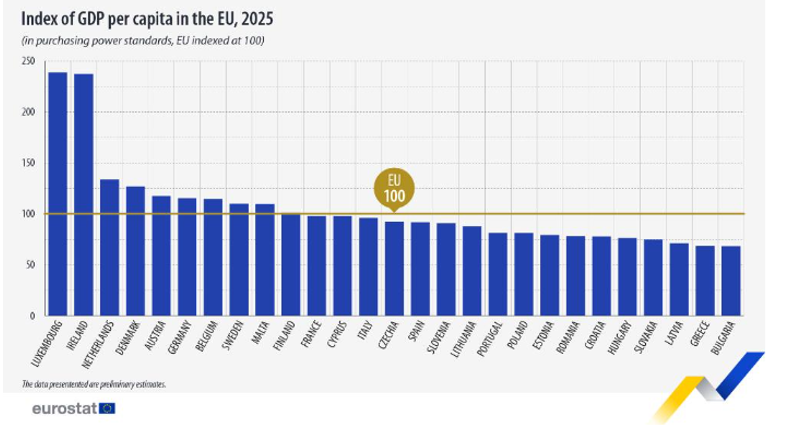
Source dataset: prc_ppp_ind_1
In 2025, substantial differences in GDP per capita expressed in purchasing power standards were observed among EU countries.
Just 10 of the EU’s 27 countries came in above the EU average in 2025, a group accounting for around 34% of the EU total population. Alongside Luxembourg and Ireland, the Netherlands, Denmark, Austria, Germany, Belgium, Sweden, Malta and Finland all exceeded the average.
Much of the rest of the EU clustered within a relatively modest distance of the mean. France, Cyprus, Italy, Czechia, Spain and Slovenia were all within 10% below the EU average, while Lithuania, Portugal and Poland sat roughly 10 - 20% behind.
The lowest level of GDP per capita was registered in Bulgaria and Greece, at 32% below the EU average, and Latvia - at 29% below.
For more information
Methodological notes
For information on upcoming releases, visit our release calendar. If you have any queries, please visit our contact us page.


Copyright © 2026 NSI All rights reserved