
Population number and structures
As of December 31, 2025, the population of Bulgaria was 6 423 207 persons. Compared to 2024, the country’s population had decreased by 14 153 persons, or by 0.22%.
Male population was 3 088 245 (48.1%) and female - 3 334 962 (51.9%), or 1 000 males corresponded to 1 080 females. Males prevail among the population aged up to 55 years (inclusive). The number and share of females in the total population had increased among the elderly.
By the end of 2025, the number of persons aged 65 and over was 1 557 851, or 24.3% of the country’s population. The share of persons aged 65 and over was highest in the districts Vidin (31.6%), Smolyan (31.1%), and Gabrovo (30.8%). The lowest was the share of the elderly population in the districts Sofia (stolitsa) - 19.2%, and Varna - 21.7%.
As of 31.12.2025, the children up to 15 years of age in the country were 891 674, or 13.9% of the total population number. The share of the population under 15 years of age was highest in the districts Sliven - 18.7%, and Yambol - 15.2%. Lowest was the share registered in the districts Smolyan - 10.0%, and Vidin - 11.4%.
As of 31.12.2025, the age dependency ratio[1] in the country was 61.6%. Lowest was the ratio in the district of Sofia (stolitsa) - 50.9%, and highest was in Vidin - 75.4%.
Population ageing over the years has led to an increase in the population's mean age. It has increased to 45.4 years at the end of 2025. The mean age of the population is 44.6 years in urban areas, compared to 47.7 years in rural areas.
The number and relative share of the population under, at and over working age change. The last two are influenced not only by the population ageing, but also by legislative changes[2] concerning the retirement age.
In 2025, at working age were women up to the completion of 62 years and 4 months and men up to completion of 64 years and 8 months. The number of the population at working age as of 31.12.2025 was 3 764 842 persons, or 58.6% of the total population, of which 1 967 204 males and 1 797 638 females.
By the end of 2025, the number of the population over working age was 1 700 684 persons, or 26.5%, and under working age were 957 681 persons, or 14.9% of the country’s population. The reproduction of population at working age is characterized by the coefficient of demographic replacement, showing the ratio between the number of persons entering working age (15 - 19 years) and the number of persons exiting it (60 - 64 years). As of 31.12.2025, the ratio was 75 persons. Most favourable is the ratio in the districts Sofia (stolitsa) - 99, Sliven - 96, and Varna - 89. Lowest is the ratio in the districts Kardhzali - 46, Smolyan - 49, and Silistra, where 100 persons exiting working age are replaced by 55 persons entering it.
Territorial distribution of population
As of 31.12.2025, 4 745 686, or 73.9% of the total country’s population, resided in urban areas and 1 677 521, or 26.1% - in rural ones. There were 5 256 settlements in Bulgaria by the end of 2025, of which 257 - towns, and 4 999 - villages. There were 192 settlements without population. In 1 280, or 24.4% of the settlements, the number of inhabitants was between 1 and 49. The largest village is Lozen (6 671 people), located on the territory of Sofia Municipality, and the smallest town is Melnik with a population of 181 persons. There were six towns with a population above 100 thousand persons and 35.8% of the country’s population lived there.
According to the country’s administrative-territorial structure, there are 6 statistical regions, 28 districts and 265 municipalities in Bulgaria.
Statistical regions
Half of the country’s population (51.9%) in 2025 lived in Yugozapaden and Yuzhen tsentralen regions. The smallest, according to the population number, was the Severozapaden region - 647 thousand persons, or 10.1% of the country’s population. Compared to 2024, the population number increased in only one statistical region - the Yugozapaden region - by 0.15%. In the other five regions, the population declines.
| Statistical region | Population as of 31.12.2025 - in numbers | Population as of 31.12.2025 - % | Population growth - in numbers | Population growth - % |
|---|---|---|---|---|
| Severozapaden | 647 273 | 10.1 | -8 157 | -1.24 |
| Severen tsentralen | 666 224 | 10.4 | -7 107 | -1.06 |
| Severoiztochen | 826 624 | 12.9 | -118 | -0.01 |
| Yugoiztochen | 951 060 | 14.8 | -1 323 | -0.14 |
| Yugozapaden | 2 026 014 | 31.5 | 3 032 | 0.15 |
| Yuzhen tsentralen | 1 306 012 | 20.3 | -480 | -0.04 |
Districts
The number of the population was lowest in the district of Vidin - 69 465 persons, or 1.1% of the country’s population, and it was highest in the district of Sofia (stolitsa) - 1 303 813 persons (20.3%). Four districts had a population above 300 thousand persons - Sofia (stolitsa), Plovdiv, Varna and Burgas.
| Districts | Population as of 31.12.2025 - in numbers | Population as of 31.12.2025 - % | Population growth - in numbers | Population growth - % |
|---|---|---|---|---|
| Total | 6 423 207 | 100 | -14 153 | -0.2 |
| Blagoevgrad | 285 644 | 4.5 | -689 | -0.2 |
| Burgas | 391 500 | 6.1 | 2 581 | 0.7 |
| Varna | 440 532 | 6.9 | 3 011 | 0.7 |
| Veliko Tarnovo | 198 803 | 3.1 | -1 610 | -0.8 |
| Vidin | 69 465 | 1.1 | -1 077 | -1.5 |
| Vratsa | 144 502 | 2.3 | -1 500 | -1.0 |
| Gabrovo | 92 722 | 1.4 | -1 095 | -1.2 |
| Dobrich | 143 858 | 2.2 | -1 349 | -0.9 |
| Kardzhali | 152 028 | 2.4 | 2 550 | 1.7 |
| Kyustendil | 104 740 | 1.6 | -1 391 | -1.3 |
| Lovech | 109 446 | 1.7 | -1 377 | -1.2 |
| Montana | 110 970 | 1.7 | -1 767 | -1.6 |
| Pazardzhik | 221 176 | 3.4 | -2 318 | -1.0 |
| Pernik | 108 871 | 1.7 | -1 015 | -0.9 |
| Pleven | 212 890 | 3.3 | -2 436 | -1.1 |
| Plovdiv | 638 290 | 9.9 | 2 660 | 0.4 |
| Razgrad | 98 083 | 1.5 | -1 376 | -1.4 |
| Ruse | 184 251 | 2.9 | -1 842 | -1.0 |
| Silistra | 92 365 | 1.4 | -1 184 | -1.3 |
| Sliven | 168 267 | 2.6 | -1 032 | -0.6 |
| Smolyan | 88 816 | 1.4 | -1 718 | -1.9 |
| Sofia (stolitsa) | 1 303 813 | 20.3 | 7 882 | 0.6 |
| Sofia | 222 946 | 3.5 | -1 755 | -0.8 |
| Stara Zagora | 286 722 | 4.5 | -2 014 | -0.7 |
| Targovishte | 93 633 | 1.5 | -1 102 | -1.2 |
| Haskovo | 205 702 | 3.2 | -1 654 | -0.8 |
| Shumen | 148 601 | 2.3 | -678 | -0.5 |
| Yambol | 104 571 | 1.6 | -858 | -0.8 |
Compared to 2024, the population had increased in five districts. The highest increase was in the district of Kardzhali - by 1.7%. Тhe highest decrease was observed in the Smolyan district - by 1.9%.
Municipalities
The distribution of the population by municipalities in 2025 was not equal. There were 81 municipalities with a population below 6 000 persons, and hardly 4.4% of the population lived there. At the same time, there were eight municipalities with a population over 100 thousand people and 41.4% of the country’s population lived there. Highest was the number of the population in Stolichna municipality (1 303 813 persons), followed by Plovdiv (333 994 persons) and Varna (331 260 persons). Lowest was the number of the population in the municipality of Treklyano - 495 persons.
| Size of municipality | Municipalities | Population | ||
|---|---|---|---|---|
| Number | % | Number | % | |
| Total | 265 | 100.0 | 6 423 207 | 100.0 |
| Up to 5999 | 81 | 30.6 | 282 263 | 4.4 |
| 6000 - 19999 | 124 | 46.8 | 1 369 506 | 21.3 |
| 20000 - 49999 | 40 | 15.1 | 1 265 734 | 19.7 |
| 50000 - 99999 | 12 | 4.5 | 844 546 | 13.2 |
| 100000 and more | 8 | 3.0 | 2 661 158 | 41.4 |
Basic factors influencing the changes of the population number and structures are the demographic processes - fertility, mortality and migration.
Fertility
There were 50 496 children born in 2025, of which 50 241 (99.5%) - live-born. The number of live births decreased by 3 187 children, or 6.0% compared to the previous year.
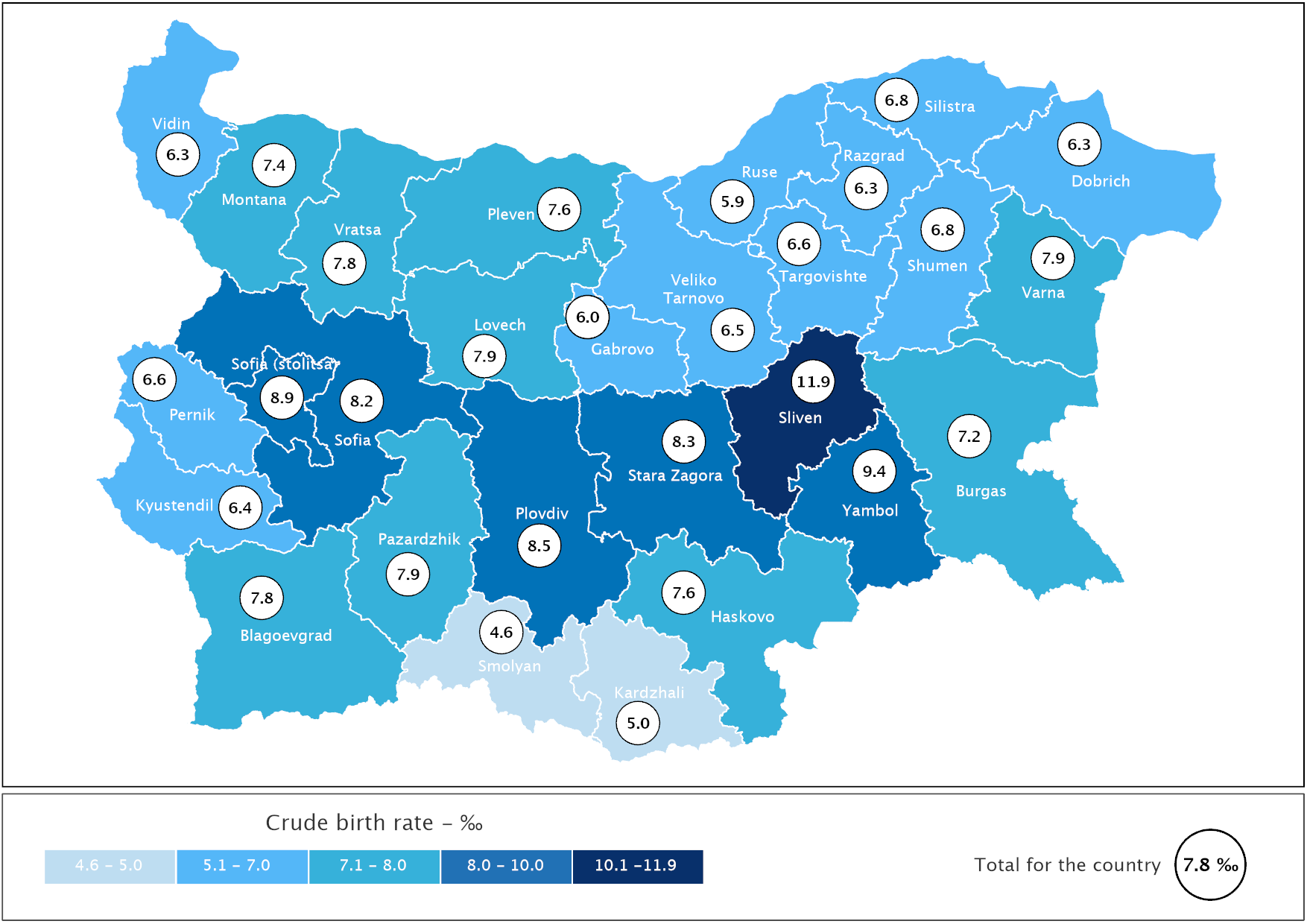
The crude birth rate[3] in 2025 was 7.8‰. The number of live-born males (25 763) was 1 285 higher compared to the live-born females (24 478), or 950 females correspond to 1 000 born males. The number of live-born children in urban areas was 37 182 and in rural - 13 059. The crude birth rate in urban areas was 7.8‰ and in rural - 7.7‰. In Bulgaria, the highest was the crude birth rate in the districts Sliven - 11.9‰, and Yambol - 9.4‰. The crude birth rate was lowest in the districts Smolyan - 4.6‰, and Kardzhali - 5.0‰.
Figure 3. Crude death rate by district in 2025
The number of women in fertile age (15 - 49 completed years), or the size and fertility of the fertile contingents in the country, influences considerably the fertility levels and the character of population reproduction.The number of women in fertile age as of 31.12.2025 was 1 246 560. It had decreased by 11 thousand compared to the previous year.
The number of live-born children born by mothers aged below 18 years decreased from 2 817 in 2024 to 2 636 in 2025. The number of live-born children born by mothers aged 40 and more decreased from 2 528 in 2024 to 2 469 in 2025.
Total fertility rate (TFR)[4] is one of the basic indicators characterising the fertility. The average number of live-born children per woman in 2025 was 1.63.
The mean age of women at first birth was 27.5 in 2025. The mean age of women at first birth had varied between 22.1 in Sliven district to 30.8 in Sofia (stolitsa) district. In 2025 49.4% of live-born children were first child for the mother and 61.5% of the children were born outside of legal marriage.
There were 846 multi-foetal births registered in 2025. In 841 of the cases two children were born, and in 5 of the cases - three children.
Mortality
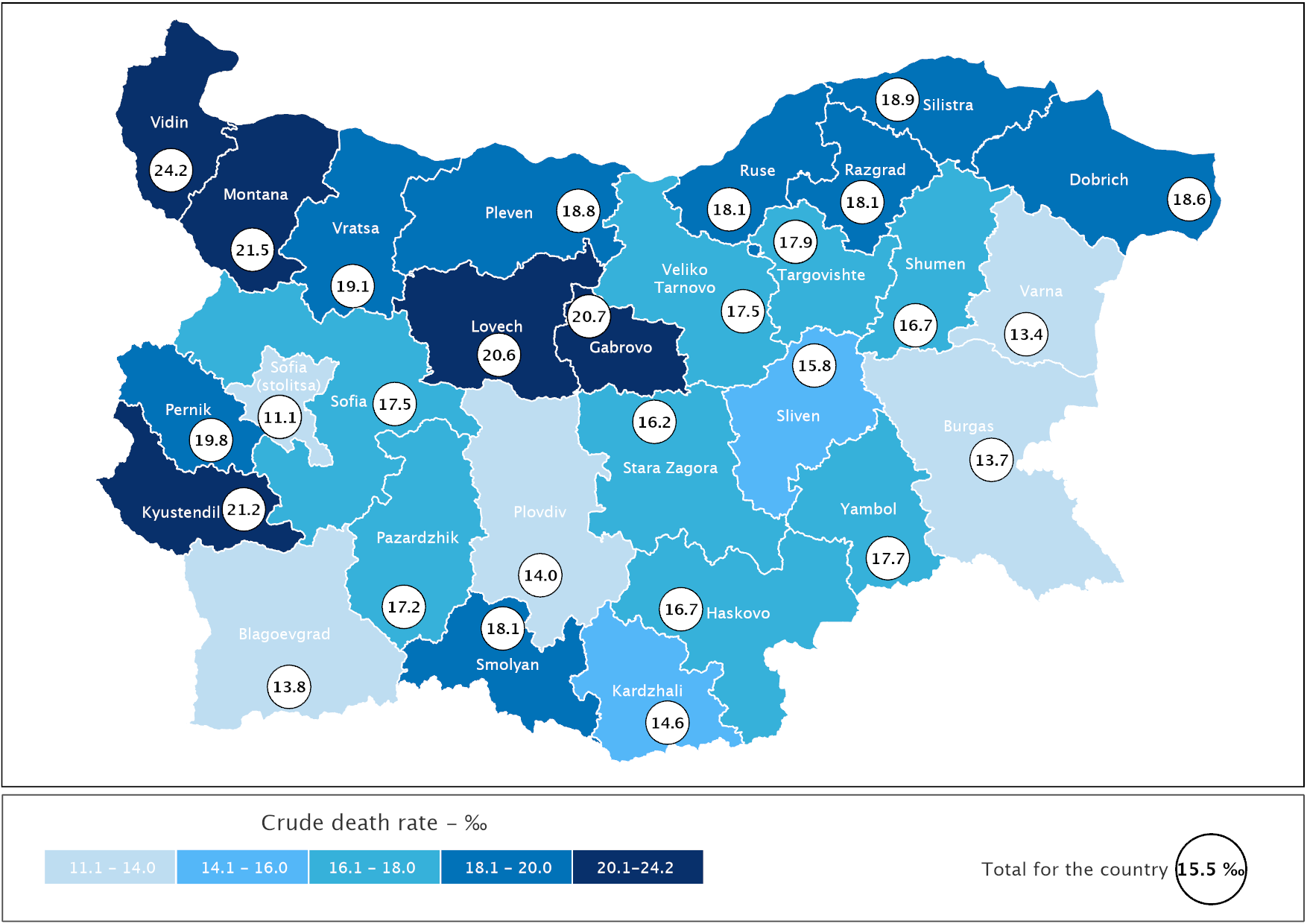
The number of deaths in 2025 was 99 479 and the crude mortality rate[5] - 15.5‰. Compared to the previous year, the number of deaths had decreased by 1 257, or by 1.2%.
Mortality among males (16.5‰) continues to be higher than among females (14.5‰). In 2025, there were 1 058 deaths of males per 1 000 deaths of females.
The mortality rate in rural areas (20.6‰) was higher than that in urban ones (13.6‰). In regional aspect, the highest mortality rate was in the districts Vidin - 24.2‰, Montana - 21.5‰, and Kyustendil - 21.2‰. The lowest was in Sofia (stolitsa) - 11.1‰.
Figure 4. Crude death rate by district in 2025
The premature mortality[6] in 2025 (19.8%) had decreased compared to 2024 (20.2%). There were considerable differences in the premature mortality indicator for the male and for the female population. The dead females aged under 65 years represented 12.7% of all dead females, while among the males the percentage was 26.6%.
233 children up to 1 year of age died in 2025 and the infant mortality rate[7] was 4.6‰. In comparison with 2015 the infant mortality rate was 6.6‰.
Marriages and divorces
There were 20 594 juridical marriages registered in 2025, or 49 fewer than the previous year. The marriage rate[8] was 3.2‰. Nearly three quarters of the total marriages number (15 320) were registered among the urban population.
The mean age at first marriage in 2025 was 34.0 for males and 31.1 for females. Compared to the previous year, the mean age at first marriage had increased by 0.3 years for males and by 0.2 for females. 83.6% of females and 83.4% of males had married for the first time in 2025. The most marriages per 1 000 people of the population were registered in the districts Sofia (stolitsa) - 4.0‰ , and Razgrad - 3.6‰. The marriage rate was lowest in the district of Pleven - 2.3‰.
The number of divorces in 2025 was 8 298, or 352 fewer than in 2024. The highest is the number of divorces by ‘mutual agreement’ (67.2%), followed by divorces due to ‘incompatibility of temperament’ (20.5%) and ‘virtual parting’ (11.7%). The average duration of a marriage before the divorce in 2025 was 14.9 years.
Internal migration
100 203 persons changed their residence within the country in 2025. Among the migrants within the country, 45.2% were males and 54.8% - females.
The share of internal migrants in the age group 0 - 14 years was 17.9%, persons aged 15 - 64 years - 65.2%, and persons aged 65 years and over - 16.9% of all internally migrated persons.
The share of the flow ‘town-town’ was the highest one (44.0%), followed by the flow ‘village-town’ (25.4%) and ‘town-village’ (21.7%). Considerably lower were the number and share of the flow ‘village - village’ (8.9%).
International migration
There were 44 640 persons who changed their address abroad to an address in Bulgaria in 2025. The flow of immigrants includes both Bulgarian citizens who had returned to the country and citizens of other countries who had received a permit or status for residence in the country, of which 45.9% were citizens of countries outside the European Union, 38.9% had Bulgarian citizenship, and 15.2% were citizens of EU countries. Males represented 52.6% of the total number of immigrants and females - 47.4%.
Among the immigrants to Bulgaria, 14.3% were in the age group 0 - 14 years, the persons aged 15 - 64 years were 72.9%, and the oldest - persons aged 65 years and over - 12.8%.
The highest was the share of immigrants from Türkiye (25.1%), Ukraine (18.5%) and Germany (9.1%).
9 555 persons changed their current address in Bulgaria to an address abroad in 2025 - 52.1% males. The emigrants aged 0 - 14 were 6.0%, those aged 15 - 64 years were 59.7%, and emigrants over 65 years of age - 34.3.
Persons who changed their address abroad to an address in Bulgaria, or the immigration flow, included Bulgarian citizens who have returned to Bulgaria and citizens of other countries who were granted residence permits or status in Bulgaria.
Population natural and migration growth
The population number and structures are defined by the size and intensity of the natural and migration growth.
The difference between the number of live births and deaths represents the natural increase of the population. The country’s demographic development after 1990 is characterised by a negative natural increase. Due to the negative natural increase, the country’s population decreased by 49 238 persons in 2025.
The population decrease, measured through the natural increase rate, was minus 7.7‰[9]. The natural increase rate in urban areas was minus 5.8‰, compared to minus 12.9‰ in rural areas.
Figure 8. Natural growth by districts in 2025
(per 1 000 persons of the population)
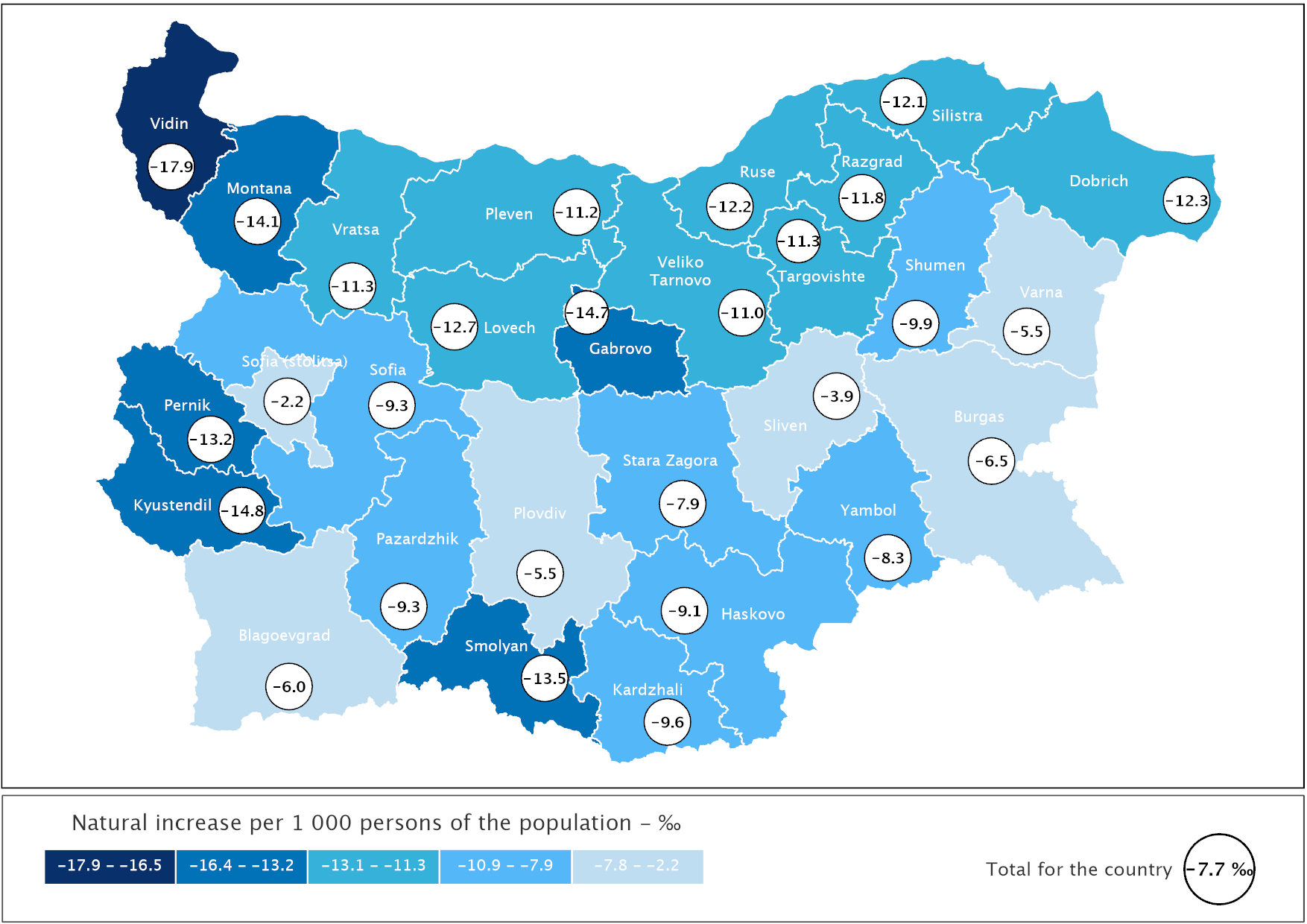
The natural increase in all of the country’s districts in 2025 was negative. The lowest was the negative growth in the districts Sofia (stolitsa) (-2.2‰), and Sliven (-3.9‰). The highest was the population decrease due to the high negative natural growth in the district of Vidin - minus 17.9‰, followed by Kyustendil - minus 14.8‰, and Gabrovo - minus 14.7‰.
Net migration (growth due to international migration) influences considerably the population number and structures. The net migration growth in 2025 was positive - plus 35 085 persons - the difference between the number of immigrants and the number of emigrants.
The decrease of population due to the international migration measured through the coefficient of net migration was +5.4‰[10].
In 2025, the highest migration growth was registered in Kardzhali (26.5‰), Burgas (13.1‰), and Varna (12.4‰). Highest population decrease due to the negative migration growth was registered in the district of Smolyan (-5.7‰).
Methodological notes
The population number and structures by the end of the year are calculated based on the population data for the preceding year and data on the population’s natural and migration movement during the reference year. In the census years, recalculation of the population is done as of the end of the respective year.
For calculation of the demographic indicators average annual population number is used. The average annual population is an average value calculated on the bases of population at the end of the previous year and at the end of the reported year.
The source of the data on population number and structures is the Statistical Register of the Population maintained by NSI. Data source on natural and migration movement of population (births, deaths, marriages, divorces, migration) is the Unified System for Civil Registration and Administrative Services of the Population (Bulgarian acronym ESGRAON). Demographic events are registered through standard documents ESGRAON-CDS (Current Demographic Statistics): notification for birth, notification for marriage, notification for divorce, notification for death and address card for change of a present (current) address.
Data sources on international migration are the Unified System for Civil Registration and Administrative Services of the Population, document ESGRAON-CDS: notification for change of present address; National Revenue Agency; National Social Security Institute; Ministry of Interior; Estimates of emigration flows.
Data on population number and demographic events are distributed according to the administrative-territorial division of the country as of 31.12 of the reference year (settlements, municipalities, districts) and statistical regions according to the ‘present address’. The last is the address corresponding to the residence declared by the person and officially registered.
The age of the population by the end of the year is calculated as of 31.12. in completed years.
The persons’ age at occurrence of a demographic event is calculated in completed years based on the date of birth and the date of the respective event, i.e., the age completed at the time of the event.
[1] Number of persons in ‘dependent’ ages (persons under 15 years of age and 65 and more) per 100 persons in ‘independent’ ages (persons aged 15 to 64 years) calculated in percentage.
[2] Age limits used for distribution of population under, at and over working age are defined according to Ordinance on pensions and length of insurance, adopted by the Decree of the Council of Ministers No. 30 (State Gazette 21/17.03.2000).
[3] Number of live-born children per 1 000 persons of the average annual population during the year.
[4] Average number of live-born children, whom a mother would give birth to during her entire fertile period according to the age-specific fertility rates during the reporting year. The total fertility rate, calculated on the basis of the fertile contingent of women, which includes women aged 15 - 49 years of age.
[5] Number of dead persons per 1 000 persons of the average annual population during the year.
[6] Share of deaths of persons below 65 years of age of the total number of deaths.
[7] Number of children who die up to 1 year of age per 1 000 live born.
[8] Number of marriages per 1 000 population.
[9] Difference between the number of live births and number of deaths per 1 000 of the average annual population.
[10] Ratio of the net migration to the average annual population.


Copyright © 2026 NSI All rights reserved