
According to preliminary data[1] from the National Statistical Institute, in the second quarter of 2026 the number of newly built residential buildings was 1 269, and the newly built dwellings in them were 5 932.
In the second quarter of 2026, 77.8% of the newly built residential buildings had steel-concrete construction, 19.6% had solid structure, 2.0% had ‘other’ and 0.6% had a panel construction. Highest was the relative share of newly built houses (76.0%), followed by blocks of flats (14.3%).
The highest number of residential buildings was built in Sofia (Stolitsa) district - 176 residential buildings with 2 046 dwellings, followed by Plovdiv district - 150 residential buildings with 375 dwellings, and Burgas district - 145 buildings with 1 369 dwellings in them (Figure 1).
Figure 1. Newly built residential buildings and dwellings completed in the second quarter of 2026 by districts
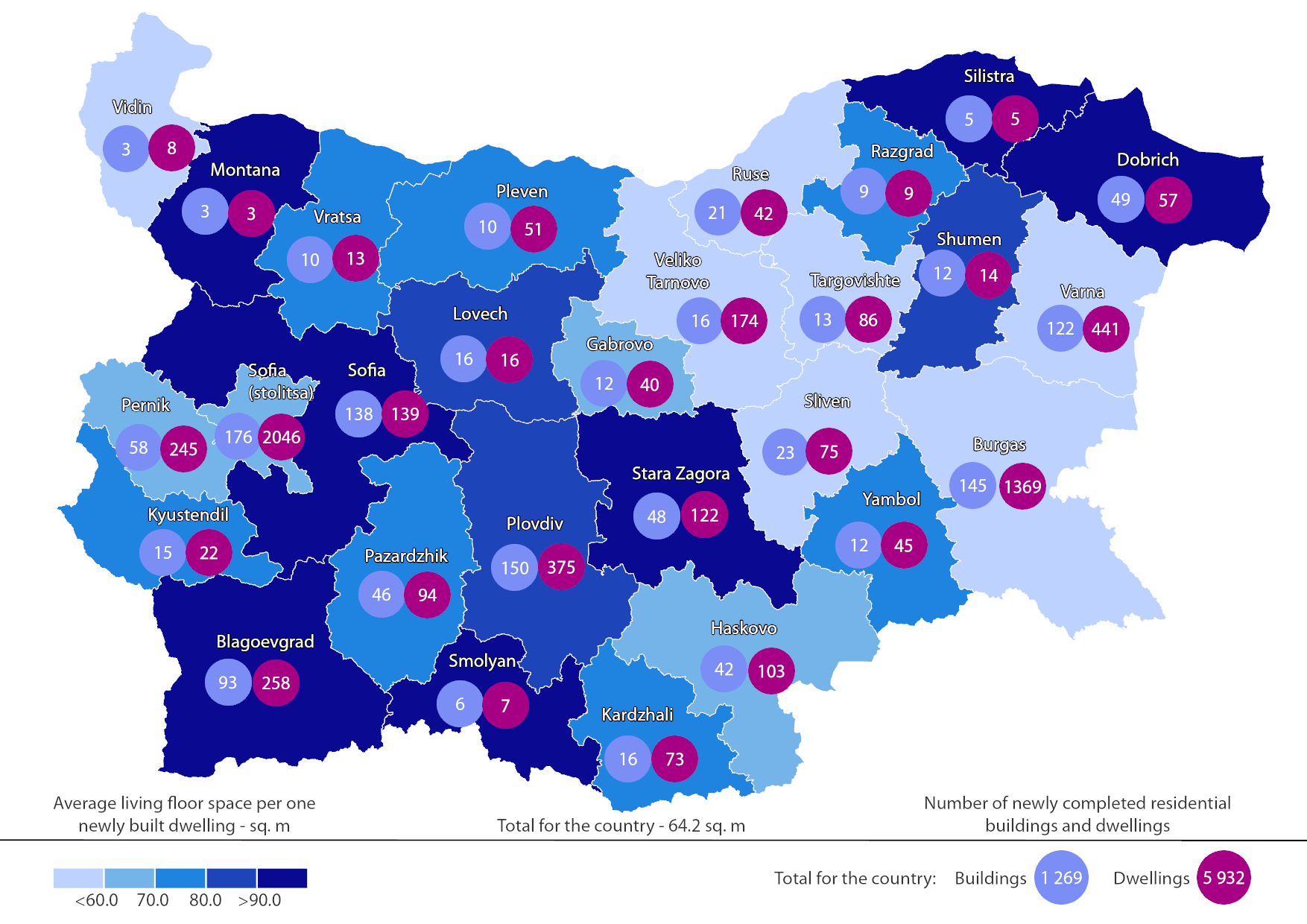
[1] The number of newly built residential buildings in the district of Sofia (Stolitsa) does not include data for Pancharevo due to the district administration's refusal to provide information.
The highest is the number of newly built dwellings with two rooms (42.8%), followed by the number of those with three rooms (33.9%), and the lowest is the number of dwellings with six and more rooms (3.2%).
In the second quarter of 2026, the total useful space of the newly built dwellings was 545.4 thousand sq. m, and the living floor space was 380.6 thousand square meters.
The average living floor space of a newly built dwelling was 64.2 square meters.
The largest average living floor space of a newly built dwelling was recorded in the districts of Smolyan - 128.4 sq. m, and Montana - 111.3 sq. m, and the smallest ones were in Targovishte - 45.6 sq. m, and Burgas - 52.4 square meters.
Methodological notes
The statistical data about the newly built residential buildings and dwellings are prepared based on quarterly reports of the municipal administrations.
In the scope of the survey are newly built residential buildings with approved or valid usage licenses according to Regulation No. 2 of July 31, 2003, issued by the Ministry of Regional Development and Public Works.
From 2025 the total area of the dwellings in the building serves as a source of information on the useful floor space. Until the end of 2024 the useful floor space of the dwellings is calculated as the sum of the living floor space and the service floor space.
Living floor space includes rooms and kitchens with over 4 sq. m of floor space.
The average living floor space is the ratio between the living floor space and the number of dwellings.


Copyright © 2026 NSI All rights reserved