
The poverty and social inclusion indicators are part of the European Union’s overall indicators for monitoring the countries’ progress in combating poverty and social exclusion. The main source of statistical data for calculating the indicators is the annually conducted ‘Statistics on Income and Living Conditions (EU-SILC)’ survey.
Poverty estimation
In 2025, the national poverty line was 866.67 BGN monthly average per household member. At this level, 1 368.7 thousand people, or 21.2% of the country’s population, were below the poverty line.
| 2021 | 2022 | 2023 | 2024 | 2025 | |
|---|---|---|---|---|---|
| At-risk-of-poverty threshold (monthly average in BGN) | 504.33 | 525.92 | 637.92 | 763.83 | 866.67 |
| Persons below at-risk-of-poverty threshold - in thousands | 1 532.0 | 1 572.0 | 1 326.0 | 1 401.0 | 1 369.0 |
| At-risk-of-poverty rate (% of the population) | 22.1 | 22.9 | 20.6 | 21.7 | 21.2 |
| At-risk-of-poverty rate before social transfers (% of the population) | 44.3 | 44.2 | 45.3 | 46.1 | 45.4 |
| At-risk-of-poverty rate before social transfers with pensions included (% of the population) | 31.5 | 30.3 | 28.5 | 30.0 | 29.0 |
| Inequality of income distribution (S80/20) | 7.4 | 7.3 | 6.6 | 7.0 | 7.0 |
| Gini coefficient[1] | 39.7 | 38.4 | 37.2 | 38.4 | 37.7 |
| [1] Calculated based on data of the distribution of persons and households by income and normalized in the range from 0 to 100 |
Compared to the previous year, the poverty line increased by 13.5%, while the relative share of the poor population decreased by 0.5 percentage points (see Table 1).
The social protection system is of great importance for the poverty decrease. Data for 2025 show that if pension income is included in the household income but other social transfers (benefits, social and family assistance, and allowances) are excluded, the poverty rate increases from 21.2% to 29.0%, or by 7.8 percentage points. Accordingly, when pensions and other social transfers are excluded, the poverty rate rises to 45.4%, or by 24.2 percentage points.
The main factor increasing the risk of falling into the poverty group for the majority of the population is their economic activity and participation in the labour market (see Figure 1). For the entire observation period, the relative share of the poor aged 18 and over is highest among the unemployed (55.1% for 2025), with the risk of poverty among unemployed men being 5.8 percentage points higher than among unemployed women.
In 2025, the share of people at-risk-of-poverty among employed individuals aged 18–64 decreased by 0.3 percentage points compared to the previous year - to 11.8%, with the risk of falling into poverty among part-time employees being approximately three times higher than that among full-time employees (see Table 2). The risk of poverty among working women is 2.2 percentage points lower than that among men.
| In-work at-risk-of-poverty rate, percent | 2021 | 2022 | 2023 | 2024 | 2025 |
|---|---|---|---|---|---|
| Employed | |||||
| Total | 10.0 | 10.0 | 11.7 | 12.1 | 11.8 |
| Male | 11.3 | 11.5 | 12.9 | 13.2 | 12.8 |
| Female | 8.5 | 8.3 | 10.4 | 10.7 | 10.6 |
| Type of employment | |||||
| Full time | 8.9 | 9.0 | 10.3 | 10.6 | 10.0 |
| Part time | 25.4 | 23.5 | 30.1 | 29.2 | 34.2 |
Educational attainment has a significant impact on the risk of poverty among employed individuals. The relative share of working poor was highest among persons with primary education or no education - 47.2% (see Figure 2). As educational attainment increases, the relative share of the working poor decreases by more than four times for persons with secondary education. The share of the working poor with a tertiary education was the lowest - 4.3%.
At-risk-of-poverty estimates by household type show that the relative share of people living in poverty was highest among households consisting of two adults with three or more dependent children (52.3% for 2025) and single-parent households with dependent children (40.4% for 2025). Among the single-person households, the risk of poverty for women was 3.7 percentage points higher than for men. In a single-person household where the age of the person is above 65 the risk of poverty was 16.0 percentage points higher than for persons aged below 65 years living in a single-person household (see Figure 3).
Poverty estimates by ethnicity[2]
Since 2015, a question regarding respondents’ ethnic affiliation has been added to the main survey questionnaire in response to the growing need for information, including poverty estimates, on households by ethnic group. Respondents self-identify their ethnic group. Answering this question is voluntary; if a person does not wish to indicate which ethnic group they belong to, the response ‘Not answered’ is recorded. Respondents are also given the option to select ‘I do not define myself’ if they are unable to determine their ethnic group. The children’s ethnic group is determined by their parents. If the parents have different ethnic backgrounds, the response that the parents mutually agree upon is recorded for the children.
[2] Due to the sample-based nature of the survey, the poverty estimates derived from the analysis are subject to a certain degree of stochastic error. To determine the stochastic precision of key poverty indicators by ethnicity, standard errors, coefficients of variation, and confidence intervals were calculated and are included in the methodological notes (see Table 8).
In 2025, those who self-identify as belonging to the Roma ethnic group had the highest at-risk-of-poverty rate - 65.5%, while the lowest was among those who self-identify as belonging to the Bulgarian ethnic group - 15.1%.
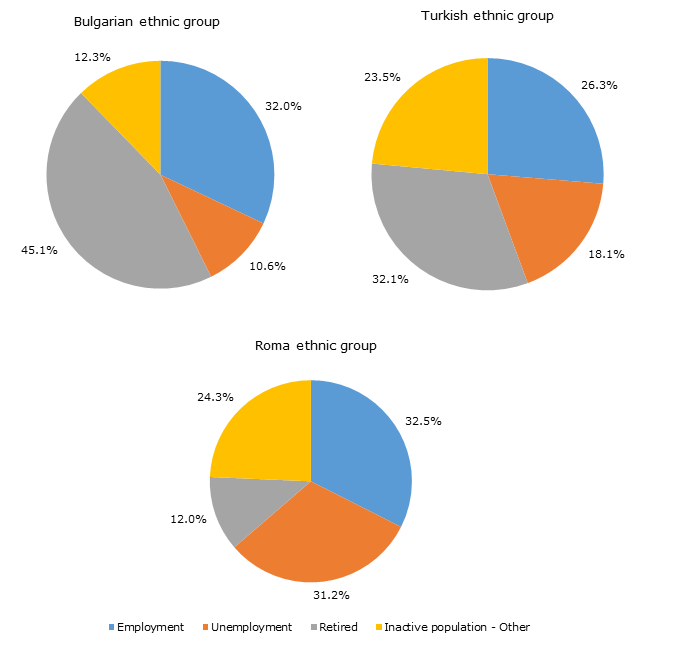
Considerable differences exist in the distribution of poverty among various ethnic groups and their economic activities (Figure 5). Retired individuals made up the majority of the poor in the Bulgarian and Turkish ethnic groups (45.1% and 32.1% respectively), while the Roma ethnic group had the highest proportion of employed persons (32.5%).
Figure 5. Share of poor aged 18 and over by economic activity and ethnicity in 2025
Material and social deprivation of households
The general indicators of poverty assessment also include subjective indicators related to material deprivation. They reflect the subjective assessment and personal attitudes of individuals and households regarding their ability to meet specific needs and requirements. Until 2020, nine questions related to the consumption of specific goods and services were used to assess households’ material deprivation. Starting in 2021, a new indicator for severe material and social deprivation has been included, which reflects the lack of necessary and desired items for leading a dignified life. It is calculated as the proportion of the population who cannot afford 7 out of 13 indicators - 6 at the individual level and 7 at the household level (see Table 3).
| Questions to the household | Deprived persons - number | Share of population - % |
|---|---|---|
| Can the household afford an unexpected required expense and pay through its own resources (urgent repair of the dwelling or car, replacement of washing machine or refrigerator, sudden illness, etc.) | 2737372 | 42.5 |
| Can the household afford, if they want, a week’s annual holiday away from home | 2519062 | 39.1 |
| Has the household been in arrears, i.e. has been unable to pay on time due to financial difficulties for any of the housing costs: mortgage repayment for the main dwelling, rent,utility bills for electricity, water, heating, etc. (without telephone expenses) | 1175444 | 18.2 |
| Can the household afford, if they want, to eat meat, chicken or fish (or their vegetarian equivalent) every second day | 1022684 | 15.9 |
| Does the household afford to keep its home adequately warm | 1039998 | 16.1 |
| Does the household have a car (incl. a company car for private use) | 643489 | 10 |
| Can the household afford to replace worn-out furniture | 2410880 | 37.4 |
| Questions to persons aged 16 and more | ||
| Availability of internet connection at home that can be used for personal needs | 321171 | 5.9 |
| Replacement of worn-out clothes by buying some new ones | 1086868 | 19.9 |
| Buying two pairs of shoes depending on the season and/or all-weather shoes | 1352332 | 24.7 |
| Spend a small amount of money each week on yourself | 1008305 | 18.4 |
| Regularly participate in sports and entertainment activities such as cinema, theatre, concert, etc. | 795727 | 14.6 |
| Get-together with friends/relatives for a drink/meal (incl. at home) at least once a month | 581470 | 10.6 |
In 2025, 15.0% of the population lived in severe material and social deprivation (restrictions in 7 out of 13 indicators), which is 1.6 percentage points less than in 2024.
Restrictions related to meeting certain needs and requirements vary by ethnic affiliation (see Table 4).
| Questions to the household | Bulgarian ethnic group | Turkish ethnic group | Roma ethnic group | Others |
|---|---|---|---|---|
| Can the household afford an unexpected required expense and pay through its own resources (urgent repair of the dwelling or car, replacement of washing machine or refrigerator, sudden illness, etc.) | 37.2 | 53.7 | 78.9 | 45.2 |
| Can the household afford, if they want, a week’s annual holiday away from home | 32.4 | 56.7 | 82.6 | 43.9 |
| Has the household been in arrears, i.e. has been unable to pay on time due to financial difficulties for any of the housing costs: mortgage repayment for the main dwelling, rent,utility bills for electricity, water, heating, etc. (without telephone expenses) | 14.3 | 21.9 | 49.7 | 20.3 |
| Can the household afford, if they want, to eat meat, chicken or fish (or their vegetarian equivalent) every second day | 12.7 | 16.7 | 43.7 | 19.3 |
| Does the household afford to keep its home adequately warm | 12.4 | 21 | 45.6 | 18.5 |
| Does the household have a car (incl. a company car for private use) | 6.7 | 12.8 | 37.9 | 5.3 |
| Can the household afford to replace worn-out furniture | 32.7 | 50.7 | 69 | 37.8 |
| Questions to persons aged 16 and more | ||||
| Availability of internet connection at home that can be used for personal needs | 4.2 | 6.9 | 22.4 | 6.2 |
| Replacement of worn-out clothes by buying some new ones | 15.8 | 29.8 | 52.1 | 21.5 |
| Buying two pairs of shoes depending on the season and/or all-weather shoes | 20.4 | 37.8 | 57.2 | 23.4 |
| Spend a small amount of money each week on yourself | 14.8 | 26.8 | 47.5 | 11.5 |
| Regularly participate in sports and entertainment activities such as cinema, theatre, concert, etc. | 12.3 | 16.6 | 36.7 | 14.7 |
| Get-together with friends/relatives for a drink/meal (incl. at home) at least once a month | 8.3 | 16.5 | 28.8 | 5.2 |
In 2025, 10.0% of the Bulgarian ethnic group, 19.9% of the Turkish ethnic group, and 55.3% of the Roma ethnic group had restrictions in 7 out of 13 indicators.
Persons living in households with low work intensity
The low work intensity for a household is calculated as the ratio between the number of months in which each household member aged 18 - 64 was employed during the previous year (actual months worked) to the total number of months that the same household member could theoretically have worked if fully employed. For individuals who report working part-time, the number of months is converted to full-time equivalents based on hours worked.
Individuals living in households with low work intensity are defined as persons of ages from 0 - 64 years living in households where adults (aged 18 - 64, excluding students aged 18 - 24) work less than 20% of their total potential during the income reference year.
Until 2020, the indicator was calculated for persons aged 18 to 59, and from 2021 onward, it includes persons aged 18 to 64.
| 2021 | 2022 | 2023 | 2024 | 2025 | |
|---|---|---|---|---|---|
| Total 0-64 years - in thousands | 421.3 | 428.5 | 322.9 | 365.9 | 355.4 |
| Share of population - % | 8.4 | 8.6 | 7.0 | 7.9 | 7.7 |
| Male - in thousands | 210.5 | 210.9 | 163.6 | 186.4 | 184.0 |
| Share of population - % | 8.2 | 8.2 | 6.9 | 7.9 | 7.8 |
| Female - in thousands | 210.8 | 217.5 | 159.3 | 179.5 | 171.3 |
| Share of population - % | 8.6 | 8.9 | 7.1 | 8.0 | 7.6 |
| Total 18-64 years - in thousands | 293.7 | 300.4 | 231.0 | 249.3 | 241.5 |
| Share of population - % | 7.7 | 7.9 | 6.6 | 7.1 | 6.9 |
| Male - in thousands | 151.7 | 151.3 | 119.7 | 127.8 | 118.4 |
| Share of population - % | 7.7 | 7.8 | 6.6 | 7.1 | 6.6 |
| Female - in thousands | 142.0 | 149.1 | 111.3 | 121.6 | 123.1 |
| Share of population - % | 7.6 | 8.1 | 6.5 | 7.1 | 7.2 |
In 2025, 241.5 thousand persons aged 18 - 64, or 6.9% of the population, lived in households with low work intensity, with their relative share decreasing by 0.2 percentage points compared to 2024, and the share of men (6.6%) was 0.6 percentage points lower than that of women (7.2%).
Combined indicator
In relation to the goals set in key areas of the ‘Europe 2030’ strategy, the Survey on Income and Living Conditions (EU-SILC) calculates a combined indicator for the regular monitoring of the countries’ progress in meeting their national sub-goals. The indicator includes at-risk-of-poverty rate, severe material and social deprivation rate and rate of persons living in households with low work intensity.
Combining the three indicators shows that in 2025 29.0% of the population, or 1 868.9 thousand people, were at risk of poverty and social exclusion (see Table 6).
The indicator’s value decreased by 1.3 percentage points compared to 2024, with a decrease of 1.4 percentage points among men and 1.2 percentage points among women.
| 2021 | 2022 | 2023 | 2024 | 2025 | |
|---|---|---|---|---|---|
| Total - in thousands | 2 193.5 | 2 206.1 | 1 933.1 | 1 952.7 | 1 868.9 |
| Share of population - % | 31.7 | 32.2 | 30.0 | 30.3 | 29.0 |
| Male - in thousands | 984.0 | 974.7 | 875.5 | 894.7 | 852.2 |
| Share of population - % | 29.4 | 29.4 | 28.2 | 28.9 | 27.5 |
| Female - in thousands | 1 209.5 | 1 231.4 | 1 057.6 | 1 058.0 | 1 016.7 |
| Share of population - % | 33.9 | 34.8 | 31.6 | 31.6 | 30.4 |
Children at-risk-of-poverty and material deprivation
In 2025, 27.0% of children aged 0 - 17 in Bulgaria were at risk of poverty, which is 1.2 percentage points lower than in 2024. Social transfers to households reduced the risk of poverty among children by 13.4 percentage points.
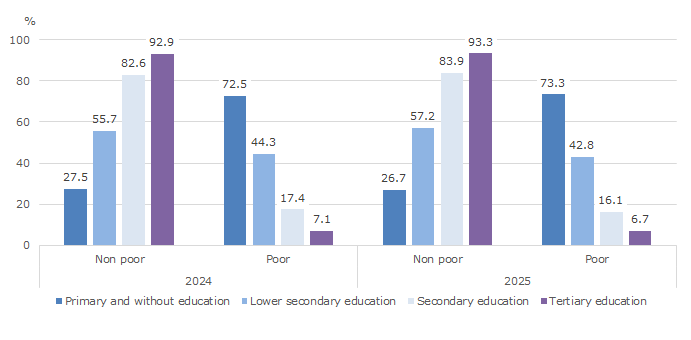
The parents’ educational attainment and occupation are important factors in their children’s future development. A higher level of education provides greater access to the labour market and, consequently, higher wages. In 2025, seven out of ten children (73.3%) whose parents have only a primary education or no education at all lived in poverty (see Figure 8). Approximately 11 times fewer, or 6.7%, are the children whose parents have a tertiary education and were at risk of poverty.
Figure 8. Share of children at-risk-of-poverty by educational level of their parents
Material deprivation among children
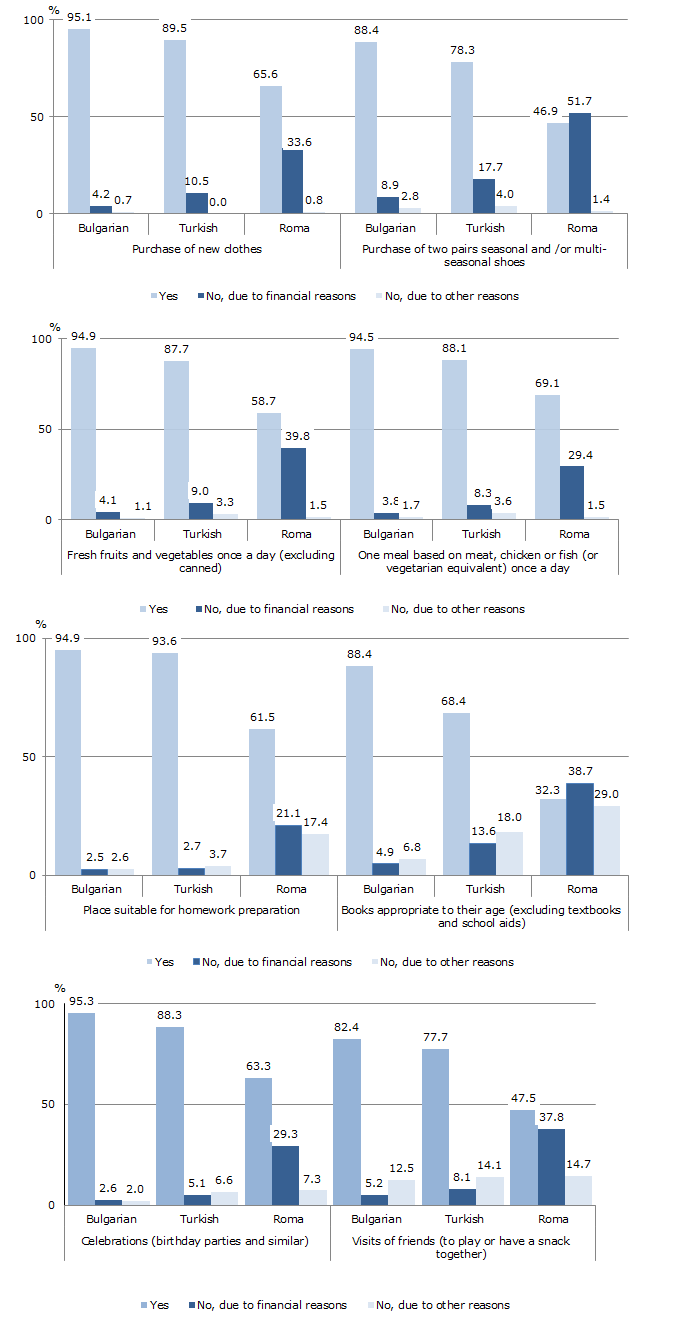
The 2013 ‘Statistics on Income and Living Conditions’ survey collects data on material deprivation among children in households (aged 1 to 15). In 2025, the relative share of children experiencing material deprivation (deprived of at least 1 of 13 indicators) was 26.7%, and for 0.9% of them none of their needs could be met due to financial reasons.
Nearly a quarter of children (22.1%) could not afford to take a week’s annual holiday away from home (including family holidays, visits to relatives or friends, school-organized trips, etc.). 18.8% could not afford equipment for outdoor activities (bicycle, rollerblades, skates, etc.), while 17.5% could not afford regular activities such as swimming, playing a musical instrument, participating in youth organizations, etc. (see Figure 9).
In 2025, 48.4% of children with material deprivation were also at-risk-of-poverty.
The ability to meet certain needs of children varies depending on ethnic affiliation. In 2025, the relative share of children experiencing material deprivation (lacking at least 1 of 13 indicators) was as follows: 17.3% of the Bulgarian ethnic group, 29.6% of the Turkish ethnic group, 73.5% of the Roma ethnic group, and 17.1% of other ethnic groups. Not a single need (limitations on all 13 indicators) could be met for 0.3% of the Bulgarian ethnic group, 0.6% of the Turkish ethnic group, and 4.6% of the Roma ethnic group. About 29.0% of materially deprived children from the Bulgarian ethnic group also lived at-risk-of-poverty. For the other groups, the relative shares were as follows: 34.0% of the Turkish ethnic group and 75.5% of the Roma ethnic group.
Figure 10. Material deprivation among children by ethnic group in 2025
Assessment of poverty at regional level
An important aspect of the study of poverty is its assessment by districts. When calculating the poverty line for each region, the same method was applied as for the national poverty line - 60% of the average total disposable net income of households in the region.
Figure 11. Poverty threshold by region in 2025
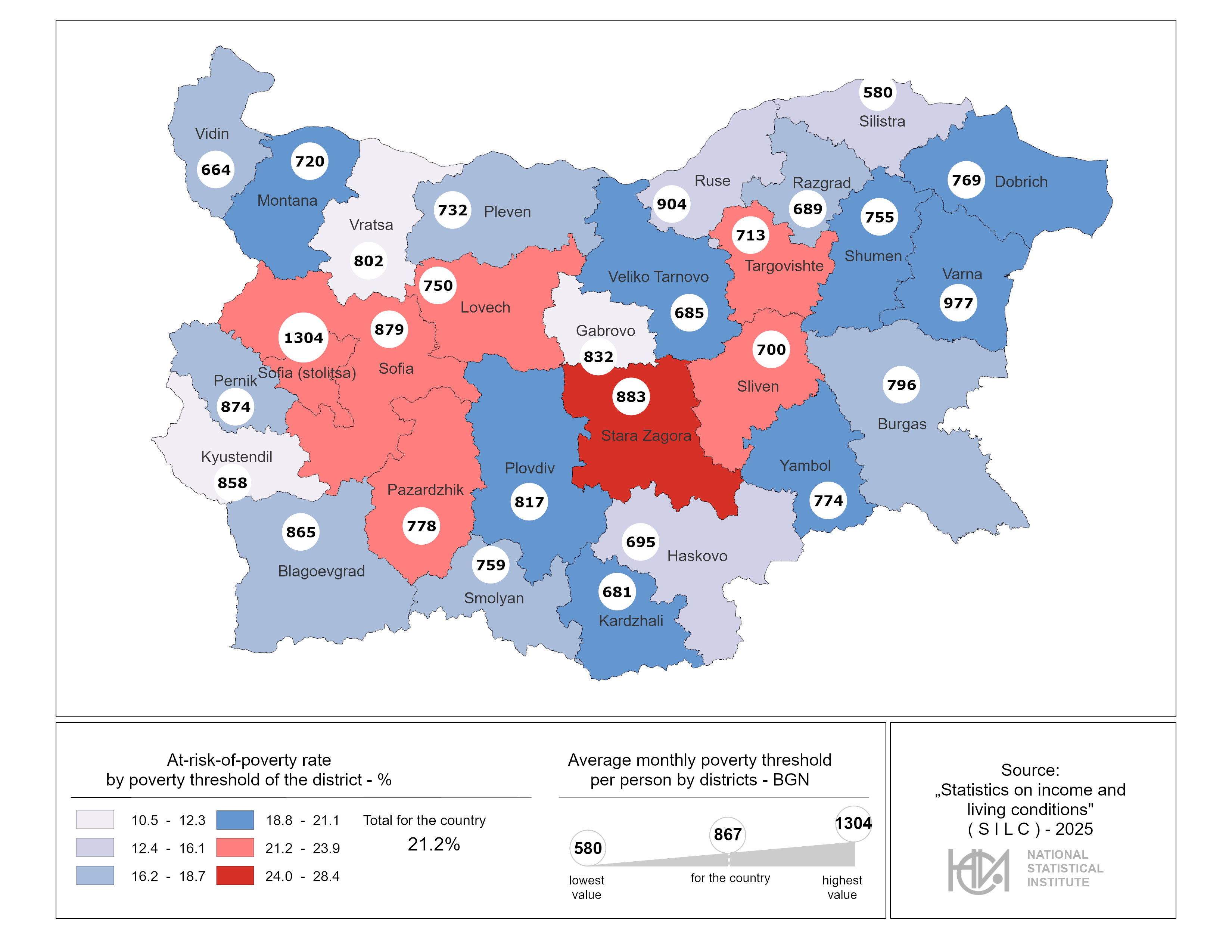
In 2025, the lowest poverty line was observed in the districts of Silistra and Vidin - 580 and 664 BGN respectively, while the highest was in Sofia (capital) district - 1 304 BGN, followed by the districts of Varna (977 BGN), Ruse (904 BGN), and Stara Zagora (883 BGN).
The highest relative share of the poor, relative to the regional poverty line was in the districts of Stara Zagora - 28.4%, Sliven - 23.9%, Targovishte - 23.7%, and Lovech - 22.8%. The lowest relative share of the poor was in the districts of Vratsa - 10.5%, Kyustendil - 12.1%, and Gabrovo - 12.3%.
Figure 12. Change of the poverty threshold for 2025 compared to 2024 and risk-of-poverty rate by gender and region
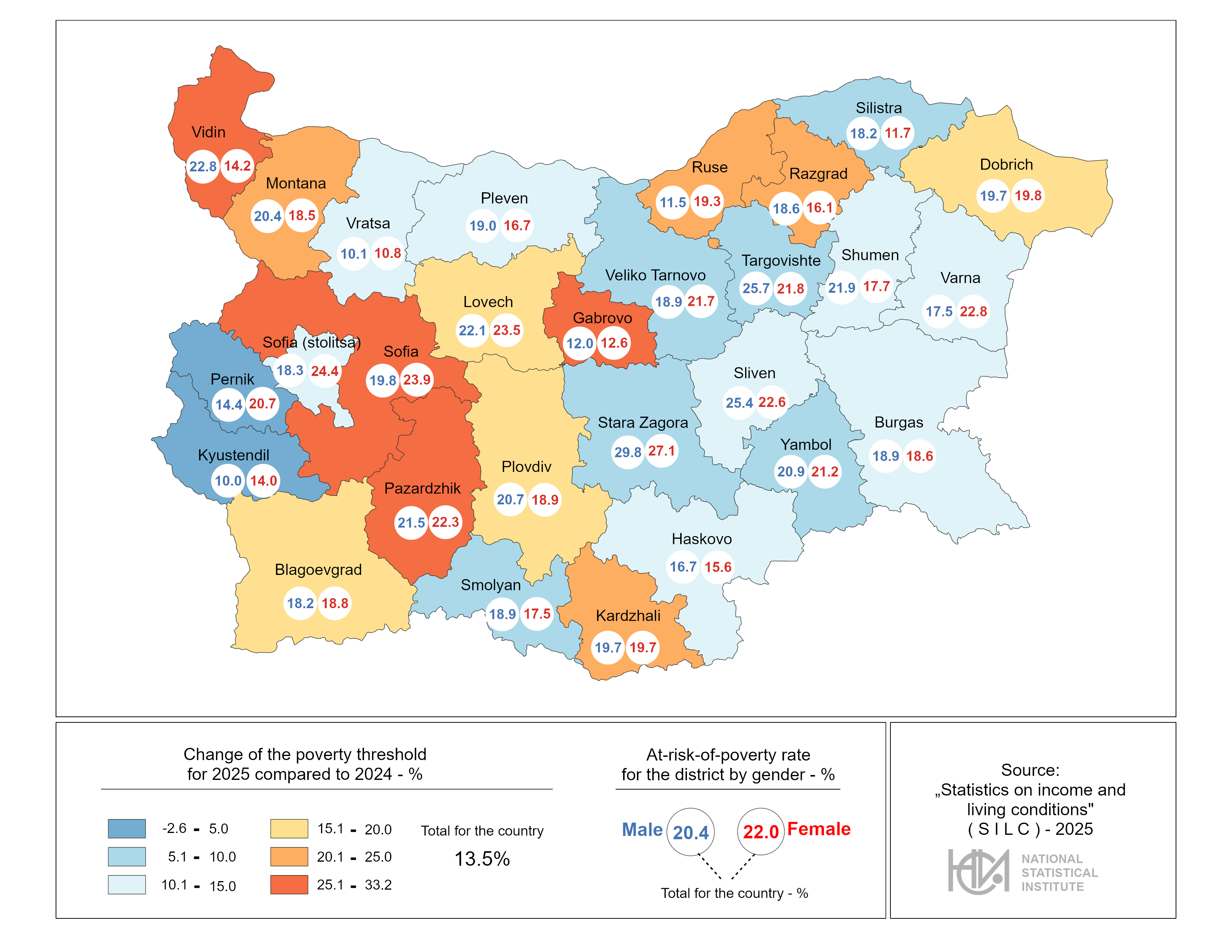
The poverty line for 2025 was higher than in 2024 in all districts except Pernik, where a 2.6% decrease was observed. The districts with the largest increases were Pazardzhik (by 33.3%), Sofia (by 29.0%), Vidin (by 26.8%), and Gabrovo (by 25.8%).
In 2025, the Kyustendil region had the lowest relative poverty rate for men - 10.0%, while the Stara Zagora region had the highest - 29.8%. In Vratsa region women had the lowest poverty rate - 10.8%, compared to 27.1% in Stara Zagora region.
The relative share of women at-risk-of-poverty was more than 5 percentage points higher than that of men in the districts of Ruse, Pernik, Sofia (capital), and Varna. In two districts - Silistra and Vidin, the relative share of men living in poverty was more than 5 percentage points higher than that of women.
Methodological notes
Regulation (EU) 2019/1700 of the European Parliament and of the Council establishes a common framework for European statistics on individuals and households based on individual data collected through sampling. The Survey on Income and Living Conditions (SILC) is one of the surveys covered by the Regulation and refers to the collection of comparable and up-to-date information on the current situation (cross-sectional data) and changes over time (longitudinal data) in income, levels and structure of poverty, and social exclusion.
The target population for the survey consists of all private households and their members residing in the country at the time of the survey. Persons living in collective households and in institutions are generally excluded from the target population.
The sample size for 2025 includes 10 147 households from 6 rotation groups across all regions of the country. In addition to the households included in the sample, all household members aged 16 and older are also surveyed. The sample consists of 6 rotation groups, with one of the rotation groups being dropped from the survey each year and replaced with a new one. This rotational sampling model provides two types of data:
The survey is conducted using two types of questionnaire forms:
Basic concepts
Poverty line
Eurostat’s methodology uses total net disposable income to measure the poverty rate. The poverty threshold is set at 60% of the average total net disposable income per equivalent unit.
Equivalent scales
Poverty and social inclusion indicators are calculated based on the total disposable net income per equivalent unit. Due to differences in household composition and size, equivalent scales are applied. The modified OECD scale is used, according to which the first adult household member aged 14 or older is assigned a weight of 1, the second adult aged 14 or older a weight of 0.5, and each child under 14 a weight of 0.3. Weights are assigned to each household member and summed to obtain the household’s equivalent size. The total disposable net income of each household is divided by its equivalent size thus creating a total disposable net income per equivalent unit.
Education level
The International Standard Classification of Education (ISCED 2011) is used to define the educational level of the parents:
ISCED 0 - Pre-primary education;
ISCED 1 - Primary education;
ISCED 2 - Lower secondary education;
ISCED 3 - Upper secondary education;
ISCED 4 - Post-secondary non-tertiary education;
ISCED 6 - Tertiary education (bachelor and professional bachelor);
ISCED 7 - Tertiary education (master);
ISCED 8 - Tertiary education (PhD).
Data weighting
The database for each country contains the following weights:
When calculating poverty indicators, the individual weight (RB050) is used, since poverty status is calculated at the individual level and the target group refers to the entire population living in private households. For some of the indicators focused on persons aged 16 and older (e.g., ‘relative share of working poor’), a personal weight (RB040) is used for persons aged 16 and older.
When calculating the indicators, the weights are adjusted using a weighting factor to account for missing cases (households with zero income) in the survey (RB050a).
Due to the sampling approach used in the Survey on Income and Living Conditions (EU-SILC), the following estimates have been calculated for certain key indicators (see Tables 7, 8, and 9):
Tabl. 7. Estimation for main indicators in 2025
Tabl. 8. Estimation for main indicators by ethnic groups in 2025
Tabl. 9. Estimation for indicator ‘at-risk-of-poverty’ by regions in 2025


Copyright © 2026 NSI All rights reserved